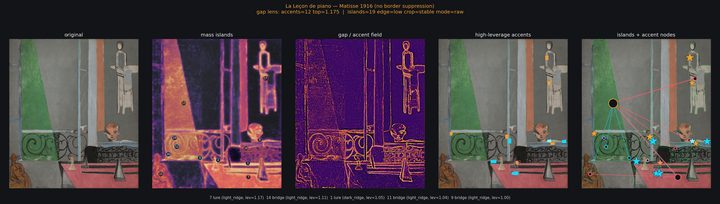
Study 01 · painting
Matisse, La Leçon de piano
Henri Matisse, 1916The foundational read: figure/ground instability and single-channel figures. The first calibration pole.
Critique
Lab book in study folder

The corpus
Thirteen deep single-work reads, one matched painting pair, one born-digital pair, and a 48-frame within-engine ensemble. Each has a lab book — the working record, with corrections and retractions intact — and a critique — the essay it earned. Together they are the instrument's calibration: every reference value it quotes traces back to one of these.
The foundational read: figure/ground instability and single-channel figures. The first calibration pole.
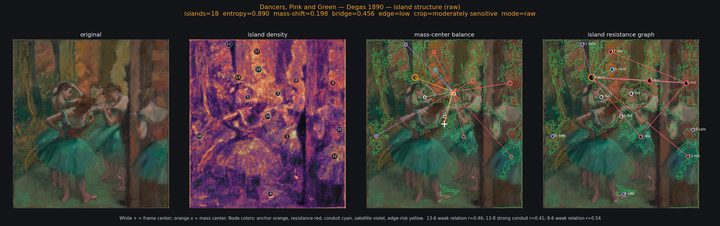
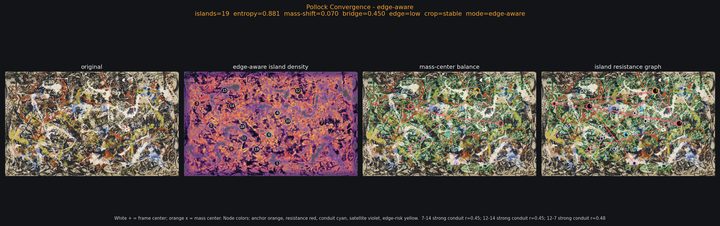
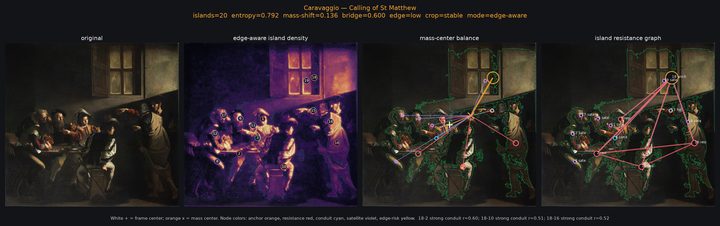
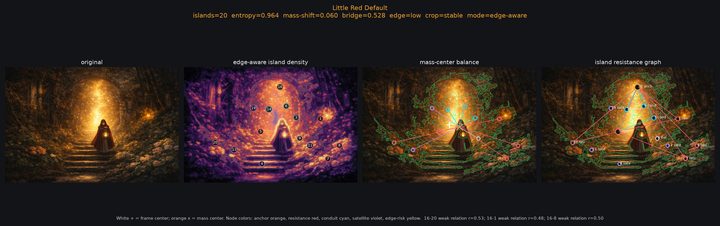
The fourth domain, and the epistemically cleanest case: the pixel array is the artifact, no reproduction chain. One prompt family spanned the corpus's full R_spatial range — arrangement, not engine statistics, sets that axis.
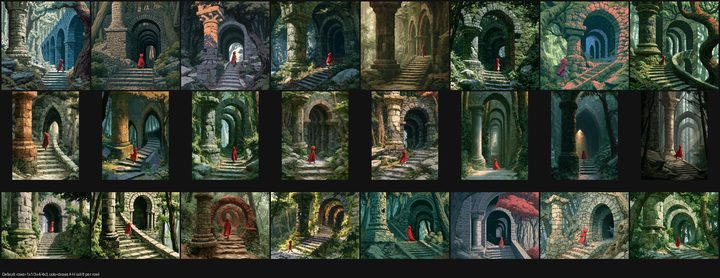
The corpus's first draw-variance measurement — claims at cohort level, in the register's first cohort-range rows. Showed the centred-emblem basin is conditional on engine and prompt, not a property of generated images as a class.
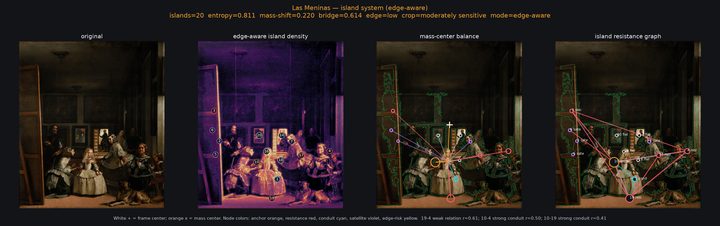
The deepest shadow-key in the corpus, on a composition that buries its nominal subjects. Earned the annular and dark-on-dark zone-read limits (I-18/19) and the third null family — a figure-position shuffle that withdrew a verdict the phase-scramble had passed.
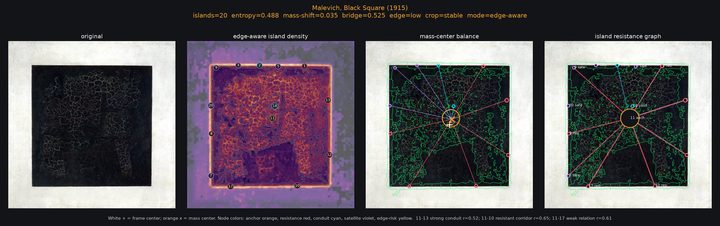
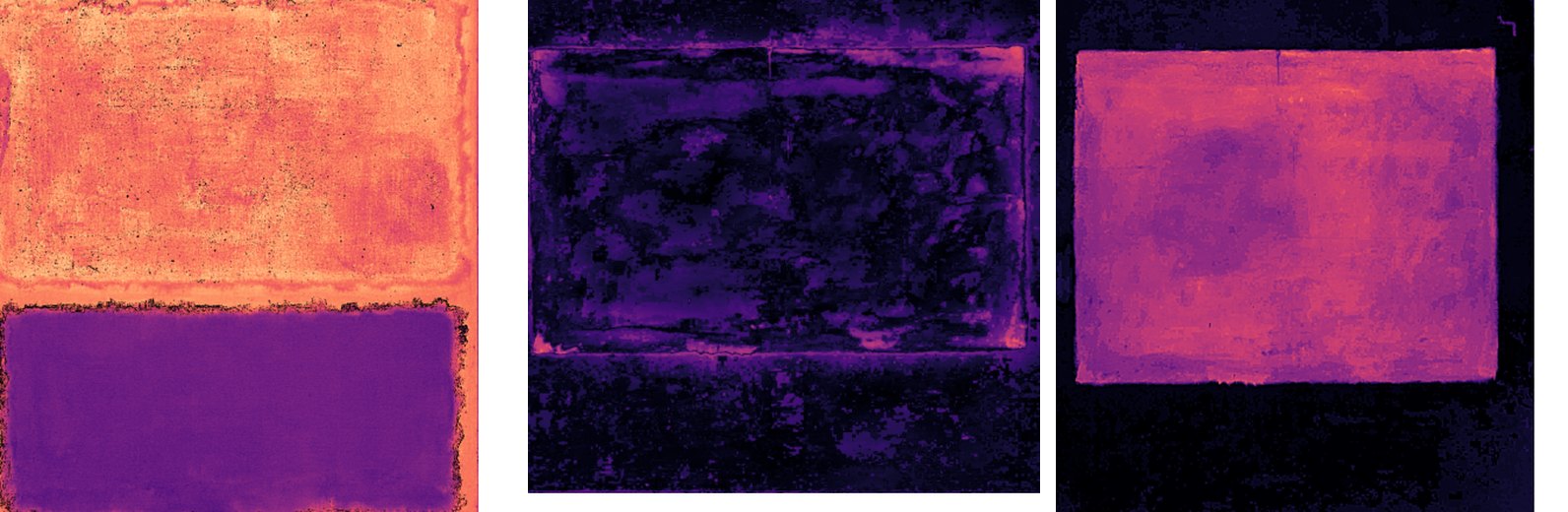
The adversarial limit: an edge-and-gradient instrument aimed at a painting built to have near-zero internal structure. Five control rounds retired four first-draft "records" (I-20), separating a clean ~1.7° hand-tilt from the century's decay. Earned the silent-zeroing fault I-23.
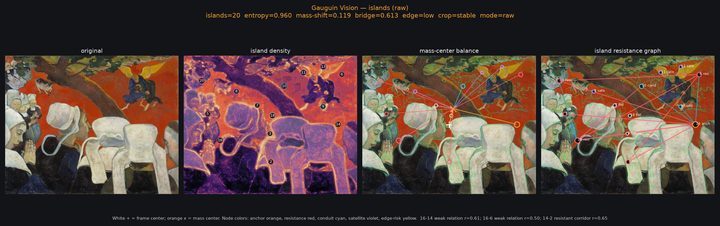
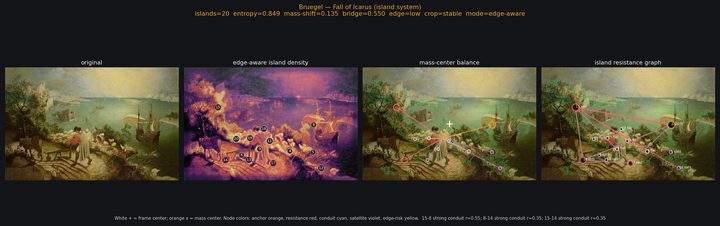
The composition delays the reveal of its own subject: scanning by salience, the instrument reaches Jacob and the angel only at the seventeenth of twenty fixations — where a centred subject is reached in the first four. Tone builds the structure, colour draws the boundaries, and neither channel shows colour building hierarchy.
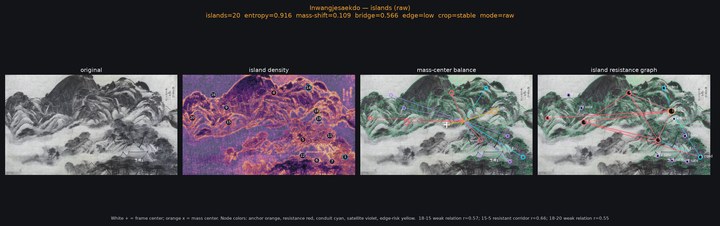
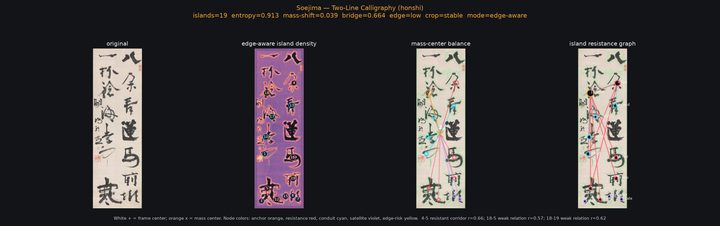
In a tradition of pale, dry restraint, Jeong Seon built his rain-black mountain in bold wet ink — and it is not one mass but two, dome and misted foreground nearly equal, held apart by a worked luminous fog. The corpus's first Korean work; every measurement, correction and retracted claim kept visible.
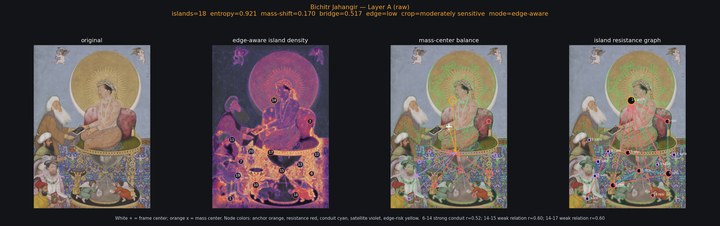
The corpus's first Mughal miniature, a picture engineered as a rank order. Three independent measures agree the emperor titled "Seizer of the World" is the least self-supporting figure in his own portrait: his weight is his gold halo, not his body, and he tonally dissolves into it. Four pre-registered bets, and in every one the phenomenon held while the tidy first metric was corrected. Findings I-33 (the composition layer under-reads tonal structure) and I-34 (worked ≠ contrast).