
A pre-semantic structural instrument
No objects, no learned weights, no training data. It computes fields over the whole surface and reads regions and their relations as one system, in one coordinate space. Every number is a deterministic function of the pixels. That constraint is the whole value.
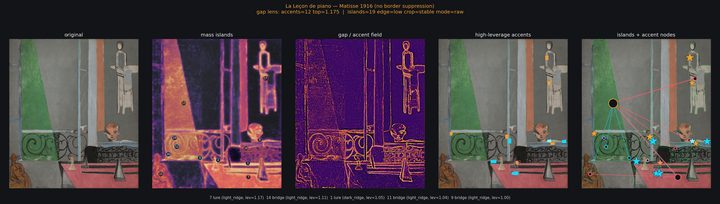
Critical language about pictures is unfalsifiable by default. "The composition pulls left" is either true or a habit of phrasing, and nothing in the sentence tells you which.
It gives that sentence a number and a place on the canvas. A claim can be checked against a measurement, and the measurement against the pixels. It does not write the sentence for you.
Every image is measured on the same axes. A Velázquez, a Meiji ink scroll, a Cartier-Bresson, and a Midjourney draw land in one coordinate space, with no interpretation needed to bridge them.
The instrument produces coordinates, not findings. Its value is a place to point. Low and high values do not mean failure or success; they expose choice and defaults, where a work sits rather than whether it should sit there.
The instrument's credibility rests on what it refuses to claim. These are not caveats added afterward. Each was earned by a documented correction, and each is enforced in how the tool reports.
| Not this | Because |
|---|---|
| Not semantic | It cannot tell a body from bark. A structural anomaly in the Degas resolved into a documented figure only through external scholarship: the instrument pointed, it could not name. Pose, gaze, and identity sit above the pre-semantic ceiling by design. |
| Not a quality score | No metric measures aesthetic value, correctness, or intent. The classifier emits
legible labels (counterweighted, diffuse_field), never grades. |
| Not a verdict | It presumes purpose. It reports what is there as though it were chosen, and that presumption cannot be falsified from inside the tool. Every read is analysis, and not every analysis is truth. |
| Not an AI detector or authenticator | Generated images cluster in certain regions, but so does deliberately stable art. Box-counting dimension is a descriptive coordinate, never an authentication statistic. |
| Not a measurement of the object | Every reading is of (object × reproduction chain × scale window). A photograph of a painting is not the painting, and every number is reported with the reproduction and resolution it came from. |
| Not a theory of composition | It carries no encoded thesis about what works should show. Each work lands where the deterministic pipeline puts it. |
Each is built on the one below. The reading walk-through takes a single painting down all four.
| Layer | What it is |
|---|---|
| Evidence fields | Nine per-pixel fields — luminance, gradient, local tone deviation, OKLab chroma, perturbation stability, structural mass, two cone-opponent channels, and soft (uncommitted) structure. Everything else derives from these. |
| The spine | One call, read_image(), returning the full structural report on a single shared region pass, so every measure describes the same regions. |
| Lenses & tools | Pointable instruments outside the spine: the accent lens for small high-leverage marks, stance, the layered delta between two images, small-corpus compare, absolute position. |
| Pattern shelf & register | Reusable analysis moves born in studies and generalised, plus the machinery that decides what is ever allowed into the spine. |
Sixteen studies across four domains: painting, calligraphy, photography, and born-digital images. Thirteen deep single-work reads, one matched pair, one born-digital pair, and a 48-frame within-engine ensemble. Each has a lab book, which is the record, and a critique, which is the essay. Corrections and retractions stay on the record.
Together they are the instrument's empirical calibration. Every reference value in the metric dictionary traces back to one of them.
Start here Reading a reading One painting, all four layers, every number named where it appears on the canvas.