Keep her isolated.
What should “keep” mean?
An agent-authored test in native video. The first interpretation keeps the character near a screen coordinate. The correction asks for a clear gap between her head/hair and the rocks, allowing her screen position to change. The same correction then governs a later passage from the other camera angle.
Keep this position.
Minimize displacement from the first revision’s head-center anchor. The character can remain well framed while her outline overlaps a rock.
Keep this separation.
Require a gap from the rock and terrain-bank silhouettes on every frame. Then minimize displacement. The meaning of the commitment changes.
Carry that meaning.
Apply the identical correction to the crossing passage, with a different camera family. Do not retune its threshold or entity bindings.
Loading frame measurements…
Across these two one-second passages, the corrected selections meet the separation rule on 48/48 frames; the position selections meet it on 0/48. Both meet the existing native geometry, contact, visibility and framing checks on every frame. An ordinary direct constraint with the same corrected rule selects exactly the same cameras. This demonstrates editable, persistent interpretation here; it does not establish a new camera capability or superiority to conventional tools.
The comparison stays honest.
Both rules search the same 108 camera paths per passage, with the same fixed 28 mm lens, inherited 0.8 m character placement, source performance, native checks and screen-position tie-breaker. Only the separation requirement changes. Each accepted path sweeps 8°. The corrected crossing uses a different angle, height and distance from the corrected approach. These are two source passages, not a continuous camera move between them.
The initial rule is an interpretation ablation, not a skilled artist baseline. The direct-constraint match is by construction, not a second independent implementation. All 216 candidate records remain available below. Projection-feasible paths are tested until the first separation failure; untested later frames remain untested. Both final choices are measured on every frame.
| Separation rule met | Position rule | Corrected rule | Direct constraint |
|---|---|---|---|
| Approach / 24 frames | 0/24 | 24/24 | Same corrected camera |
| Crossing / 24 frames | 0/24 | 24/24 | Same corrected camera |
| Approach / anchor RMS drift | 2.1% | 11.0% | Same tradeoff |
| Crossing / anchor RMS drift | 1.5% | 6.7% | Same tradeoff |
| Existing native checks | 48/48 | 48/48 | Same checks |
Anchor drift is a normalized two-axis screen-coordinate error. Separation costs screen-position fidelity; that movement is explicitly permitted by the correction. These are correlated frame observations from one previously used scene, not 48 independent trials or an untouched-shot benchmark.
See what the monitor measures—and what it misses

The declared threshold is 2% of image width (12.8 pixels at the 640-pixel render width). Rays at a 320×180 grid sample the background under the head/hair convex envelope and an expanded buffer. The nearest included surface is rejected if it belongs to a rock object or a terrain face steeper than 45°. The corrected clips have no forbidden sample within that buffer; clearance beyond the buffer is not measured. This is a sampled proxy, not a subpixel contour guarantee.
The scene test includes 1,319,672 triangles from 78 rock/mountain instances and three terrain meshes. Rock geometry was checked during the initial native renders; the unchanged paths retain those receipts. The new path verifies head/hair geometry against the extraction record. Terrain triangles are checked at passage endpoints. The monitor uses a static environment snapshot.
Flatter ground, shadows, plants, lighting contrast and emotional isolation are not part of this predicate. A clear rock gap can still be an unappealing composition. Native visibility checks sample rays; they do not certify artistic readability. Review the actual film separately from these proxy measurements.
Rendering uses a common foreground-defocus setting in all four clips, applied after the geometry-based selection. No generated frames, source retiming, character reshaping or environment relocation. Preview render quality is unchanged.
The first passing score missed the intended relationship
The first check bound only named rock objects. Its selected approach passed numerically but still placed the character against a rocky terrain bank. Adding convex terrain patches overcorrected: their envelopes filled empty space. The final check uses nearest intersections with the actual surface triangles. The terrain binding and measurement representation were corrected; the camera pool, separation threshold and native guards stayed fixed.
Watch the initially misleading comparison → · Read the correction history →
That failure matters more than a clean score alone: a preserved rule can preserve the wrong interpretation. This example records an agent making and correcting that mistake; it does not impersonate a human teacher.
Whose correction is this? What has actually been learned?
This phrase, correction, entity bindings and numeric threshold were specified by the agent under the user’s instruction to proceed. They are not recorded user preferences, a human teaching session or a learned linguistic distinction. The initial protocol preceded the search. Visual inspection exposed missing terrain bindings; a convex terrain approximation then overfilled empty space. Both failures were retained. The final native-triangle rule was fixed before its repeat search and carries the same payload and SHA-256 identifier into both passages. This is a development experiment, not a preregistered benchmark.
RFS’s Changing alphabet and Second chamber motivate making interpretation correctable and keeping the source of a decision visible. Here that idea is tested as an explicit geometric rule in native video. The system does not discover a new concept or train a model from the correction.
The remaining research question is whether an author can introduce a useful distinction without an engineer writing its predicate, then carry it into unfamiliar work with less repair than a competent direct workflow. This experiment supplies a replayable test case; it does not settle that question.
The decision is inspectable.
Download the correction, complete frame checks, every candidate score and native camera recipe. A small Blender replay script renders either interpretation from the unchanged original Settlers asset. Source libraries are required; this is not another packed scene download.
Settlers — Blender Studio / Blender Foundation · CC BY 4.0. Existing source assets unchanged. No API credits used.
Latest: new Spring passage and human review ↓ · Two guided revisions, controls and findings ↓ · Frozen-canyon video and findings ↓ · Original character restored ↓ · Contour cleanup and contact findings ↓
Change the shot.
Keep the action.
One character. Two substantial revisions. Watch what changes—and what survives.
ORIGINAL GEOMETRY / SOURCE TIMING
The stumble is still unresolved.
Frames 83–174 contain a longer squash-and-stretch performance, including a face-first fall. None of the tested fixed-lens paths satisfied both the 12% minimum head height and protected-character framing throughout this passage.
That may expose a poor readability proxy as well as a limited camera family. The source performance is not being “repaired” to satisfy the metric. This is a bounded search failure, not proof that the shot cannot be made.
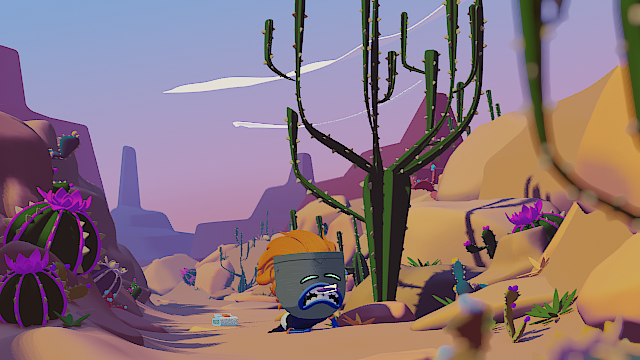
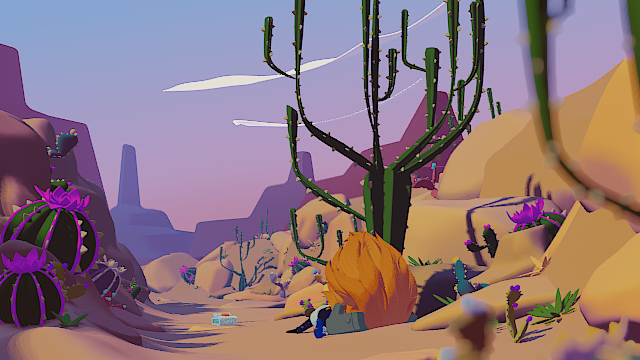
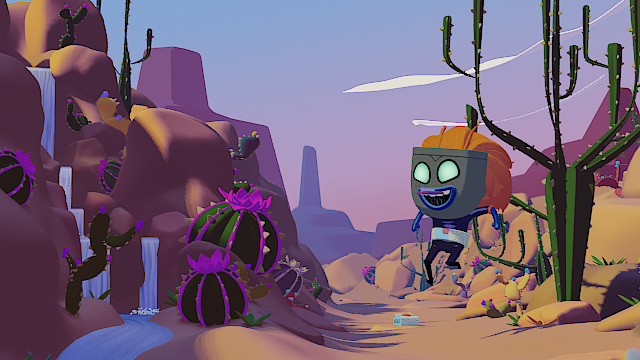
The backpack is already released in the source. Its relative motion is preserved; the released prop is excluded from the always-in-frame character envelope.
Loading native evidence…
The performed moment.
The source establishes the walk, expression and attachment behavior.
Come closer. Move right.
Move the character 0.8 m and bring the camera in. Retain the performance and ground relationship.
Keep that. Change sides.
Carry the placement and decisions forward. View the same action from the other angle.
A revision can have a parent.
The second edit inherits the first edit’s placement and the same five commitments. Native geometry and camera checks run over every frame. The downloadable Blender file contains four named scene views, with the performance still editable.
Two walking passages pass both revisions. They are one second each, from the same development asset. The longer stumble remains unresolved. These are preview-quality Blender renders, not generated or interpolated video.
Whose decisions? What changed during the test?
Your requirement was that the difference be obvious. “Keep the character readable and the action intact” is the agent’s recommendation under that brief. The 12% head-size, 95% sampled visibility and 2 cm ground thresholds are agent interpretations.
The first proposal moved the character left again in revision two. It failed obstruction and ground checks. The accepted amendment carries the first revision’s 0.8 m placement instead. Rejected results are retained in the portable package.
Framing protects head, hair and body, plus the backpack when its center is within 2 m of the head. All four meshes are checked for source-relative geometry preservation, including when the backpack is released. Foreground blur is adjusted once per clip; the environment geometry stays fixed.
| Measured check | Revision 1 | Revision 2 |
|---|
Geometric head size and sampled environment rays are proxies. They do not establish artistic readability, optical visibility, gaze or full collision. Refractive FX is excluded from opaque occlusion rays.
The earlier direct-control reference also passed its checks. This round adds repeatable inheritance and fixed-lens continuity; it does not measure reduced artist effort or outperform a skilled conventional workflow. Independent artistic judgment and untouched scenes are still needed.
Four views. One editable file.
Packed-scene verification loading…
Use Blender 3.4’s scene selector: Approach / revision-1, Approach / revision-2, Crossing / revision-1, Crossing / revision-2. The original performance action is retained separately in the file.
Settlers — Blender Studio / Blender Foundation · CC BY 4.0. Camera and placement revisions by this project. Source assets unchanged.
The world changed.
Some decisions moved.
One direct Runway Aleph 2 edit turns the desert into a frozen blue canyon. The brief asks it to keep the character, performance, released backpack, camera and terrain layout. This is the uncorrected model output: no native character pixels have been composited back in.
The broad fall, recovery and jump closely correspond in the inspected samples. Hair shape and character details are redrawn, and terrain features are reconstructed. This result is retained as a direct-model baseline. Exact preservation was our strict probe; the redraw can still be an acceptable creative choice. See the source-restoration comparison below for a different choice.
| Commitment | Observed result |
|---|---|
| Frozen environment | Clearly visible in reviewed samples. |
| Duration / frames | 92 → 92 frames; 24 fps; 3.833333 seconds. Full decode passed. |
| Fall / recovery / jump | Broad sequence appears retained at sampled timestamps; exact performance is not certified. |
| Exact character appearance | Does not pass: hair silhouette, finish and character details change. |
| Exact terrain layout | Does not pass: familiar composition, reconstructed rock contours and smaller features. |
| Released prop continuity | Unresolved; requires closer tracking and temporal review. |
Actual charge: 84 credits. Balance after this run: 416. One upload and one generation through the Runway developer API. The earlier Weave attempt was blocked before upload. The previous generated style still was excluded because it had changed character and geometry. This is the historical first-run balance. Two later guided revisions and the current balance are recorded below.
Review combines full media decoding with eight sampled visual comparisons and an end-frame close inspection. It is agent review on the existing development shot, not independent evaluation. A background change alone establishes no new control capability or advantage over current tools. The later guided ice-to-amber continuation is now complete. The next comparison below restores the original character to test selective preservation without another paid generation.
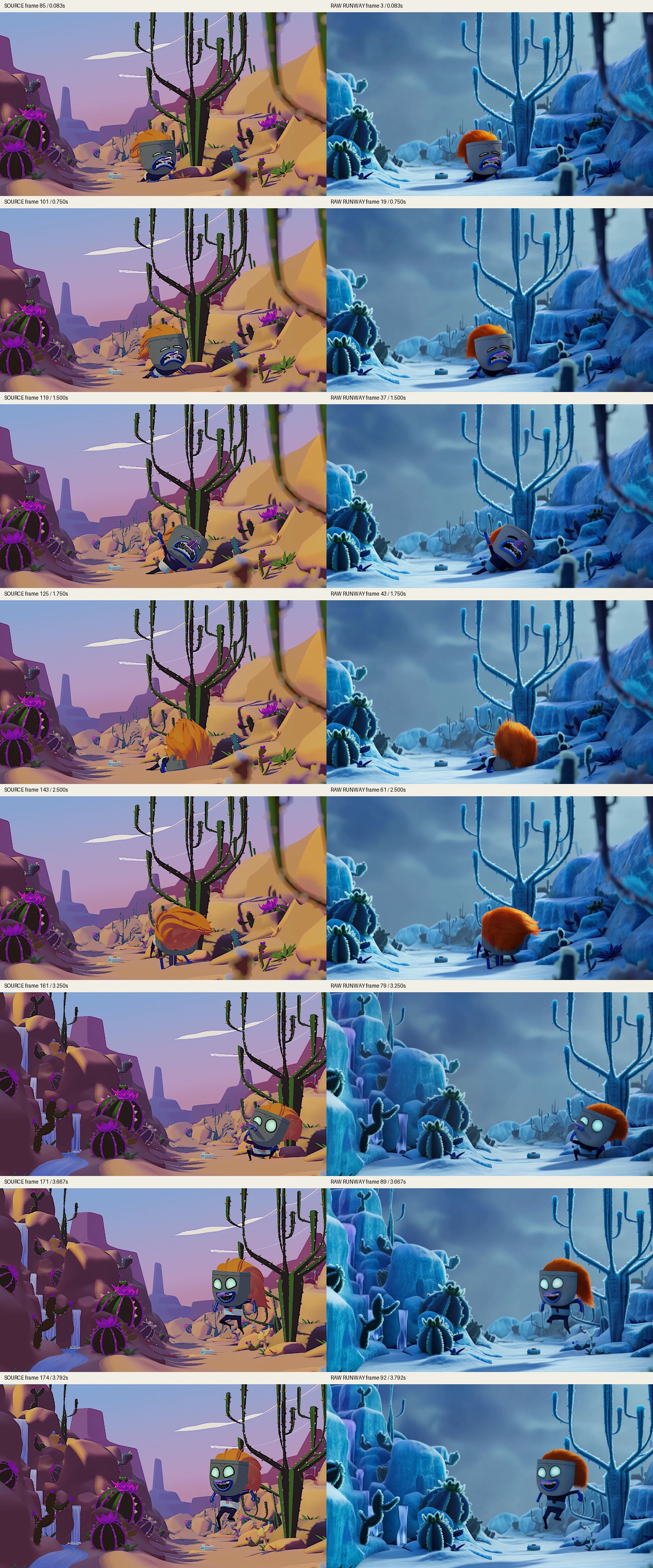
Prepared inputs, original brief and unused style reference
The original plan: frozen-blue environment, then warm amber dawn, carrying the same performance and layout commitments. The input archive is the preserved pre-run preparation snapshot, not the current result record.

Source: Settlers — Blender Studio / Blender Foundation, CC BY 4.0. Frozen-canyon adaptation generated with Runway Aleph 2. Prompt and review by this project.
Keep this character.
Keep the new world.
The redraw is a valid interpretation. Here we exercise a different choice: retain the original character and prop while using Runway’s frozen environment. Original beauty-frame pixels are composited through the existing diagnostic geometry masks. No further generation, inpainting, relighting or tracking correction was applied in this restoration stage.
The source hair, face and body are visibly restored. But replacing the original silhouette does not erase the generated character outside it. Exposed generated contours and limbs can remain, particularly during recovery and the jump. Original edge colors and render detail also stand apart from the new world.
| What this does | What remains open |
|---|---|
| Copies source pixels inside opaque mask coverage. | Removes neither generated character pixels beyond that coverage nor all optical edge contamination. |
| Keeps the generated environment outside coverage. | Does not establish correct contact, cast shadows, reflections or new occlusion relationships. |
| Preserves source timing across all 92 frames. | Does not certify a convincing composite throughout the motion. |
The copy check is a construction check, not a quality score. Before video compression, fully covered pixels equal the native source and uncovered pixels equal the downsampled Runway result on all 92 frames. That follows from compositing. The H.264 previews are lossy. The masks are geometric diagnostics, not production beauty alpha, and omit optical effects such as refraction, transparency, motion blur and shadows.
This is a simple conventional baseline, not a skilled compositor benchmark or a new preservation algorithm. The next trial below clears the generated character’s displaced footprint and exposes the remaining contact tradeoff. If ordinary compositing solves it well, that establishes the baseline Afterimage must match or exceed.
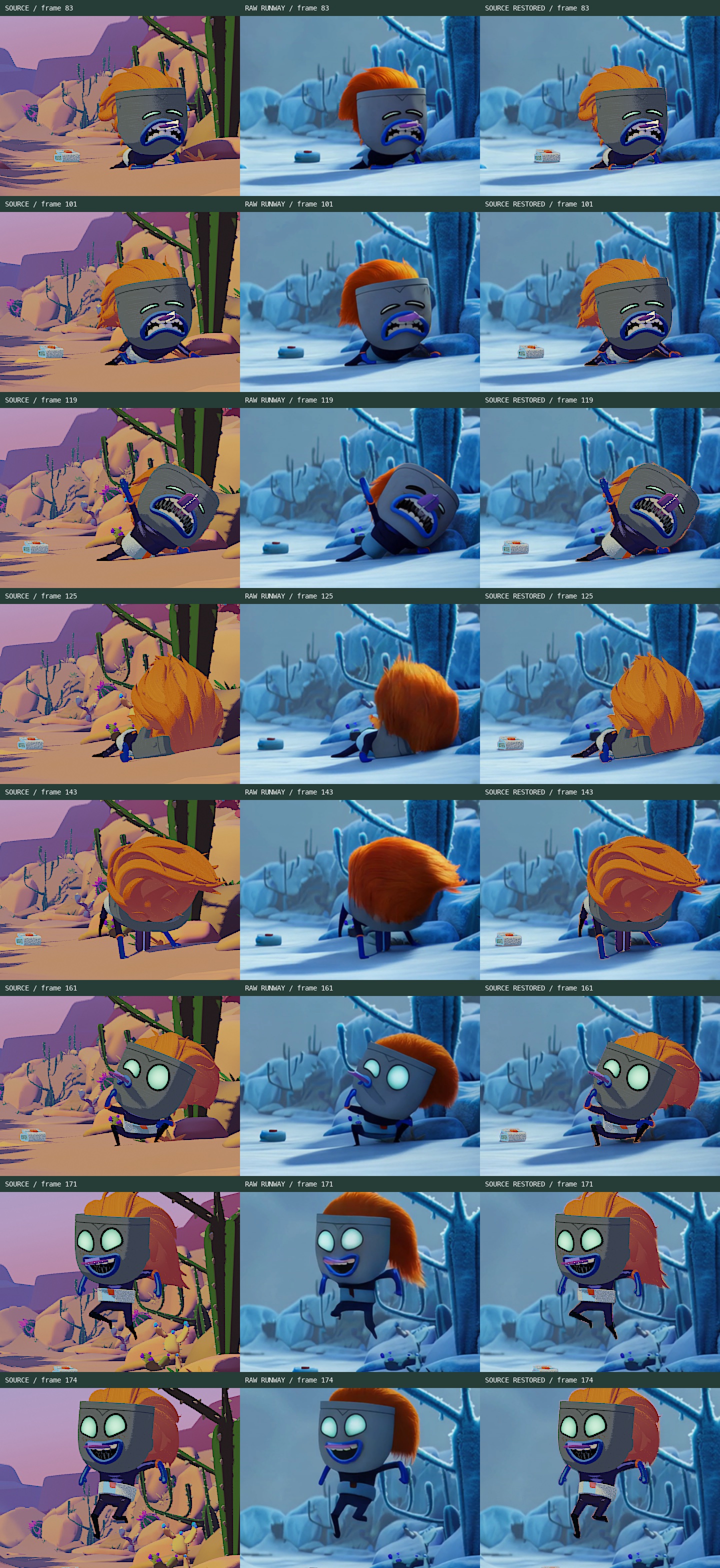
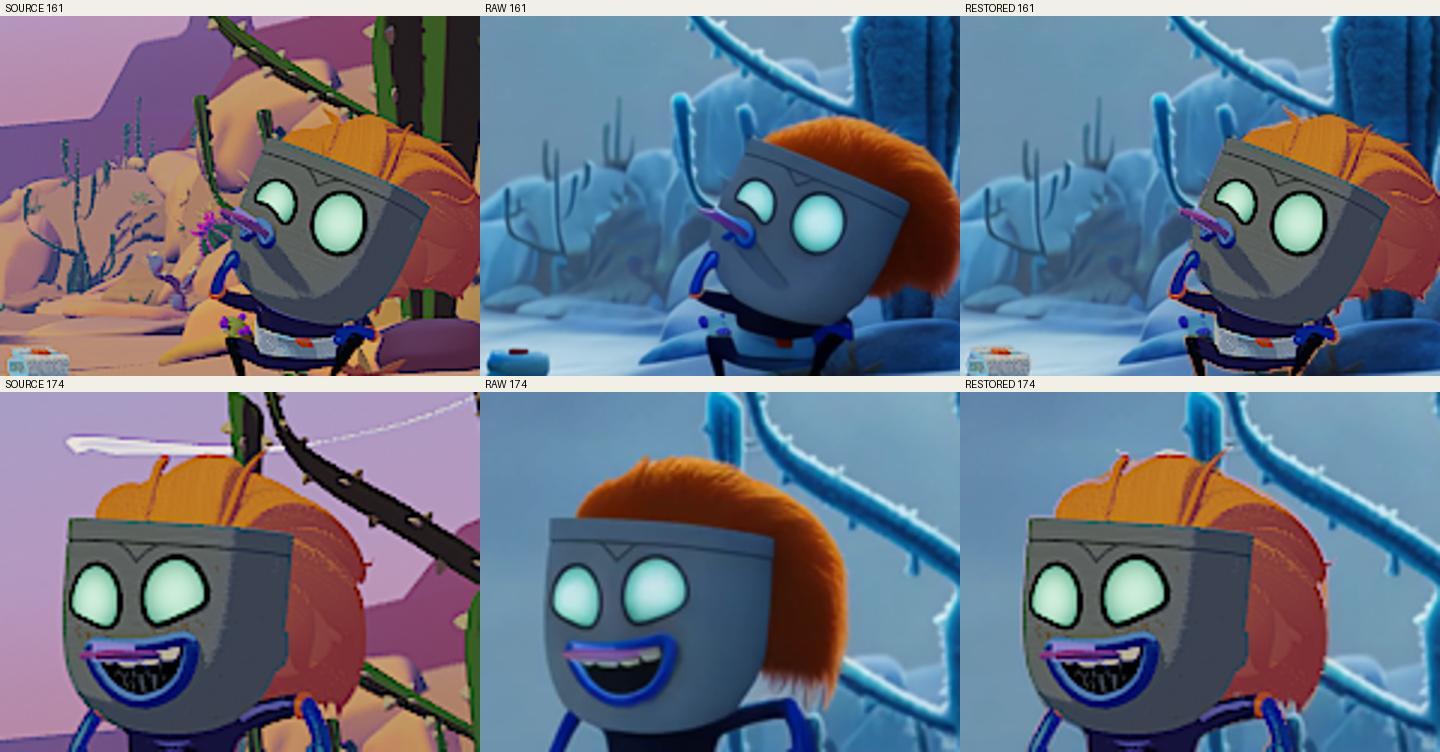
Settlers — Blender Studio / Blender Foundation, CC BY 4.0. Environment adapted with Runway Aleph 2. Conventional source restoration by this project. No new API calls or credits used for this stage.
Clean up the redraw.
Restoring the source character left parts of Runway’s differently shaped character exposed. This trial clears an inferred generated footprint, reconstructs the exposed background, then restores the original character. The earlier source-over result remains the comparison.
The inspected comparisons show reduced generated character residue outside the source silhouette. Full cleanup also introduced a pale lower edge in the face-down pose. The selected trial keeps a narrow band of the earlier composite beneath the grounded character to reduce that artifact. It can retain some old residue there; physical contact and shadows are not solved.
| Operation | Evidence and limit |
|---|---|
| Clear the generated footprint | Native-guided image segmentation; inferred coverage, not ground truth. Margins are agent choices. |
| Reconstruct exposed background | Median from at least three registered frame donors where available; local fill elsewhere. Can smear detail or flicker. |
| Keep source character interiors | Opaque native-mask interiors remain source-exact before video compression. Partial edge colors are approximated. |
| Preserve visible contact cautiously | Keep a narrow lower-contour band from the earlier composite on frames 83–169. This is a disclosed screen-space exception, not a physical shadow solve. |
About 78% of the initial reconstruction area used background donors and 22% used local fill, before the contact exception. These are method counts across frames, not success rates. All 92 frames are retained; sampled visual review does not certify flicker-free motion.
The character still carries its original lighting and render detail. Making it belong fully in the icy world would permit a different commitment: preserve identity and performance while allowing relighting. This stage does not silently make that choice, establish a skilled-compositor advantage, or turn conventional cleanup into a novelty claim.
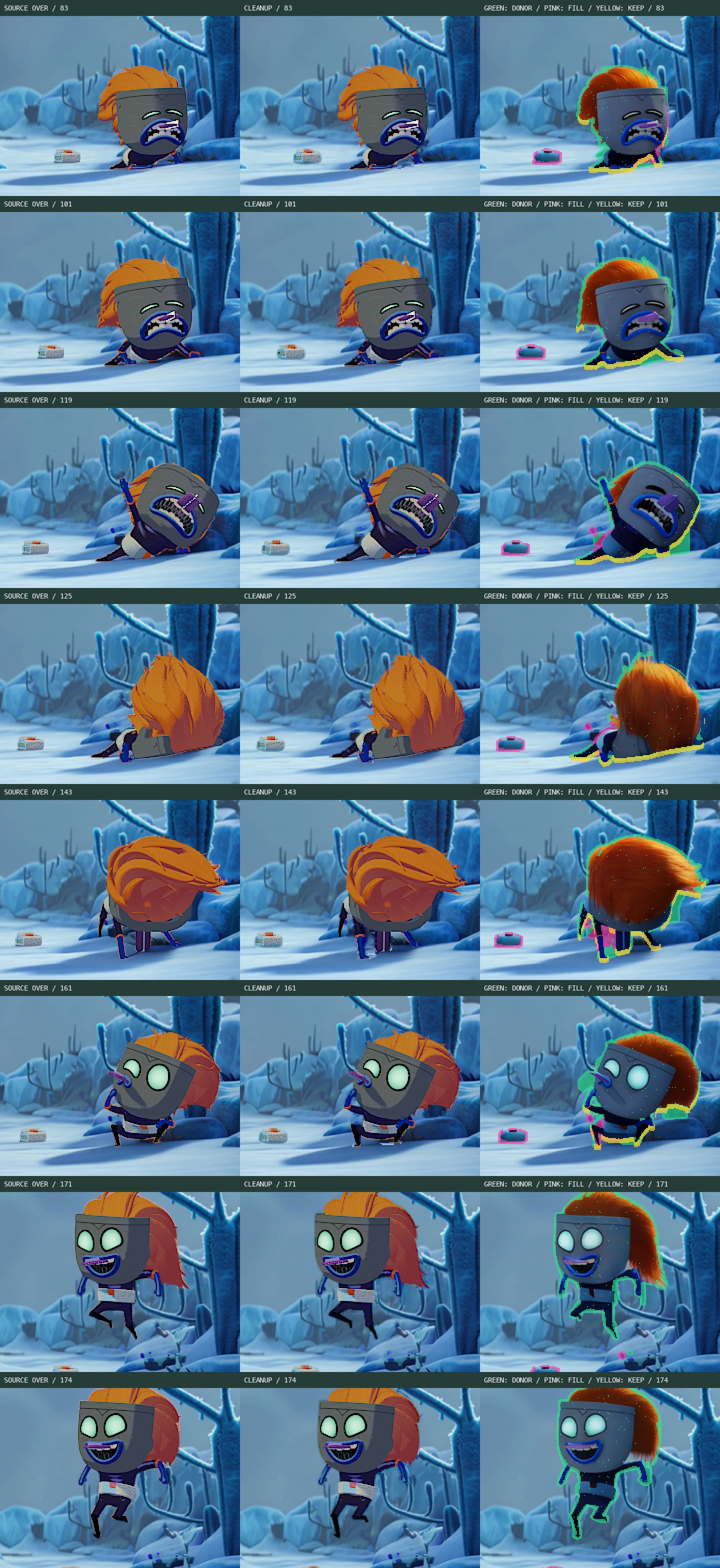
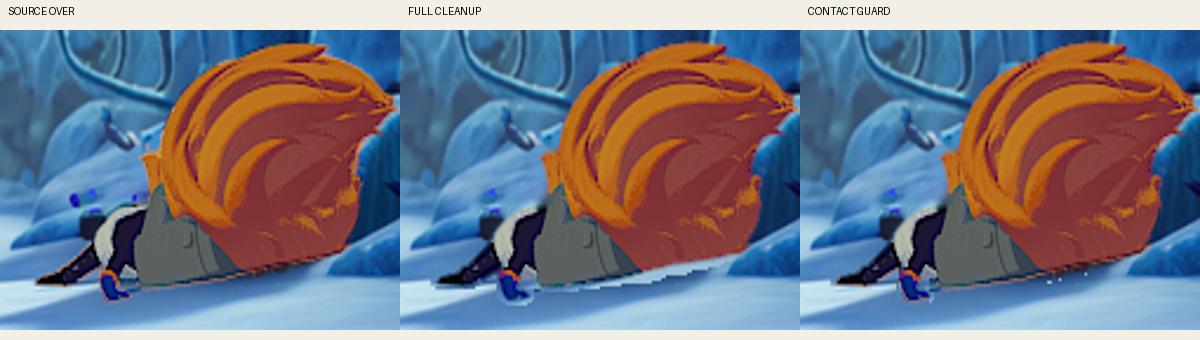
Source: Settlers — Blender Studio / Blender Foundation, CC BY 4.0. Frozen environment generated with Runway Aleph 2. Conventional cleanup by this project. 0 additional API calls or credits. The original footage, raw generation and earlier restoration are retained.
Change the world.
Carry the character.
Desert → frozen canyon → amber dawn. Keep the recognizable character, swept hair, facial structure and performed action; allow illumination and surface shading to change. These are the raw model outputs, with no character restoration between the two calls.
The performed character.
Five timed reference frames reassert identity and performance. The source, guides, prompts, seed and review criteria were frozen before generation.
A different light.
The world becomes icy, then warm dawn enters the icy world. Original pixel colors are not a protected decision in this test.
The actual first result.
The second call uses the first raw output as its video input. Original identity anchors are supplied again. This is external guidance, not evidence of model memory.
Both transformations are visible, and the sampled action carries through both revisions. Fine hand, body and facial contours still change at the unguided jump. The amber sky and illumination shift strongly between frames 155 and 158, immediately after the final guide. These are raw outcomes, not repaired successes.
| Question | Guided ice | Guided amber |
|---|---|---|
| World change | Frozen blue canyon realized. | Amber direction realized; ice retained. |
| Character & hair | Recognizable and close to guides. Fine contours change at the unguided jump. | Recognizable identity persists. Fine contour differences remain. |
| Action & timing | Fall, recovery and jump correspond in sampled frames. | Broad order and corresponding poses persist. Exact all-frame equality unmeasured. |
| Prop continuity | Visible in matching sampled region; exact trajectory unverified. | Visible in matching sampled region; exact trajectory unverified. |
| Look continuity | No large extra shift identified in declared samples. | Strong late sky/lighting shift after final guide; unresolved. |
| File integrity | 92 decoded frames · 24 fps · 1080p | 92 decoded frames · 24 fps · 1080p |
Agent visual review of 13 timestamp-matched samples per revision: five anchors and eight unguided samples, including the final jump. All 92 frames decode; that technical check does not certify identity or motion quality. Independent judgment remains pending.
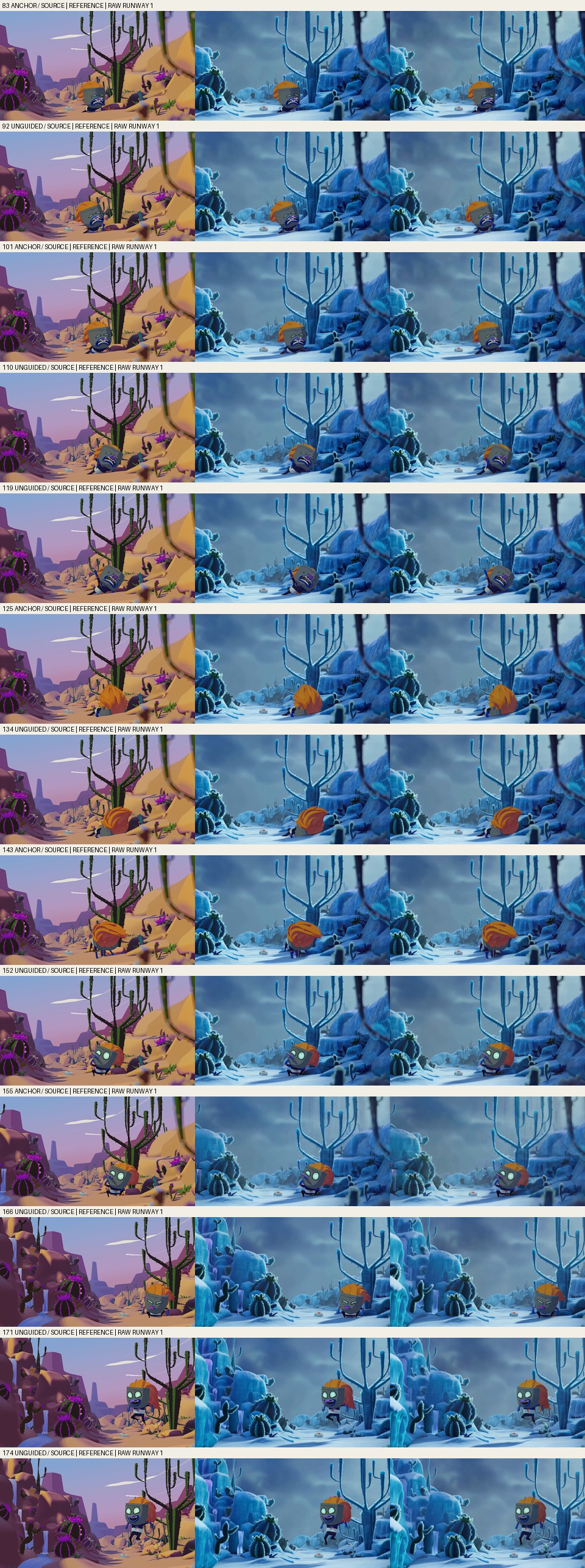
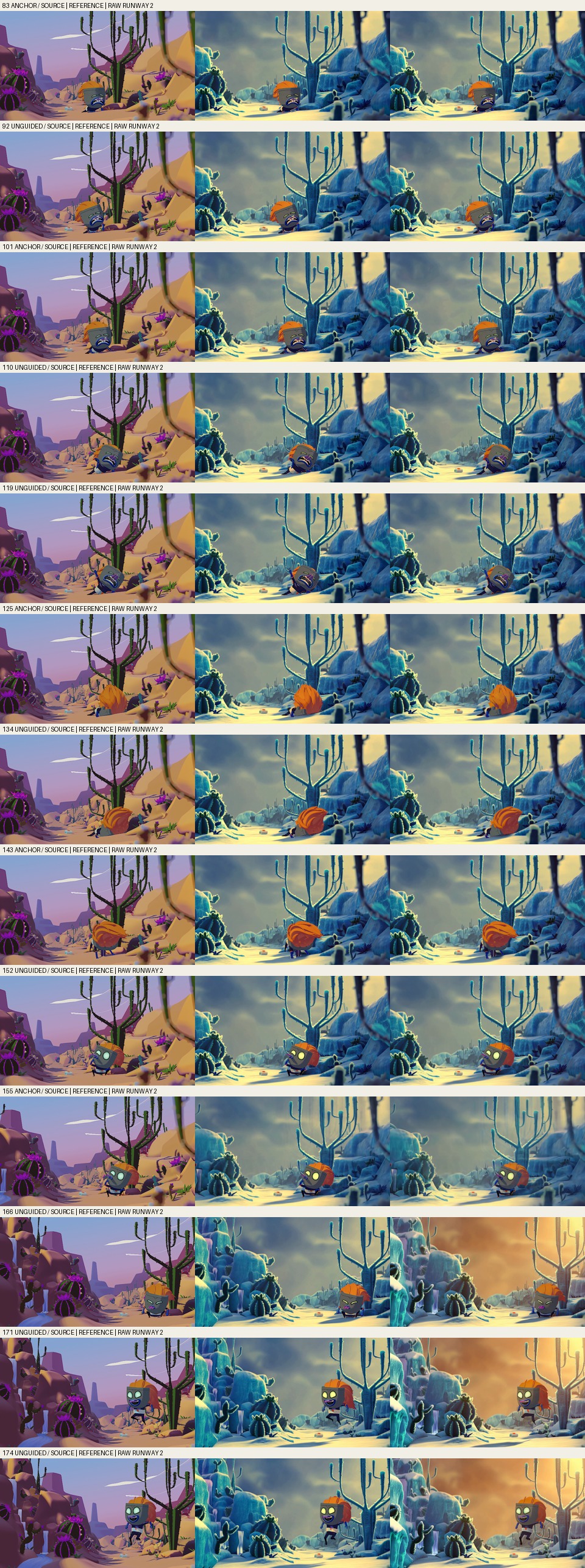
What was controlled—and what was not?
Runway Aleph 2, SDK 5.20.1, seed 20261001, MP4, five timed guides at 0, 0.75, 1.75, 2.5 and 3 seconds. No edit range or aspect-ratio override. Default moderation. One accepted generation per revision; no rerolls. Both raw outputs are retained. Input, guide and parent-output hashes are in the receipts. Stage one takes a 1280×720 upload; stage two takes the exact 1920×1080 returned file, including its compression. Those inherited differences are recorded, not normalized away.
The initial final guide at 3.79 seconds was rejected: the service validated a maximum of 3 seconds for this 3.83-second clip. Two identical unpaid validation rejections preceded a documented amendment to source frame 155 at 3 seconds. No generated result had been viewed. The final jump has no direct guide.
The documented workflow uses timed edited frames. The official SDK exposes no regional preservation mask, CFG, denoising strength or sampling-step setting. Internal preprocessing and model weights are not controlled here. The seed promises similar results for an identical request, not an exact replay.
The older text-only run used a different prompt and stricter appearance constraints. It remains historical context; this is not an isolated causal test of adding keyframes.
What counts as evidence?
Transformation: the requested frozen world and amber direction must be visible. Preservation: character shape, facial identity, action and prop continuity must survive at matching times, including unguided frames. Continuation: the second edit must carry the selected decisions forward. These are separate judgments; polish cannot compensate for changed action or identity.
The conventional reference is the existing native-character restoration in a generated frozen plate, then fixed color grading. It is not physical relighting. It has all-frame native masks while the model receives five images, so it is not an equal-information algorithm benchmark. Its inherited edge/contact limitations remain. No independent artist completion, labor comparison or superiority claim is supplied.
One development shot and one seed per stage establish a bounded workflow observation. They cannot establish generalization or a new capability beyond existing tools. The next evidentiary step would require untouched shots and independent judgments under the same stated brief.
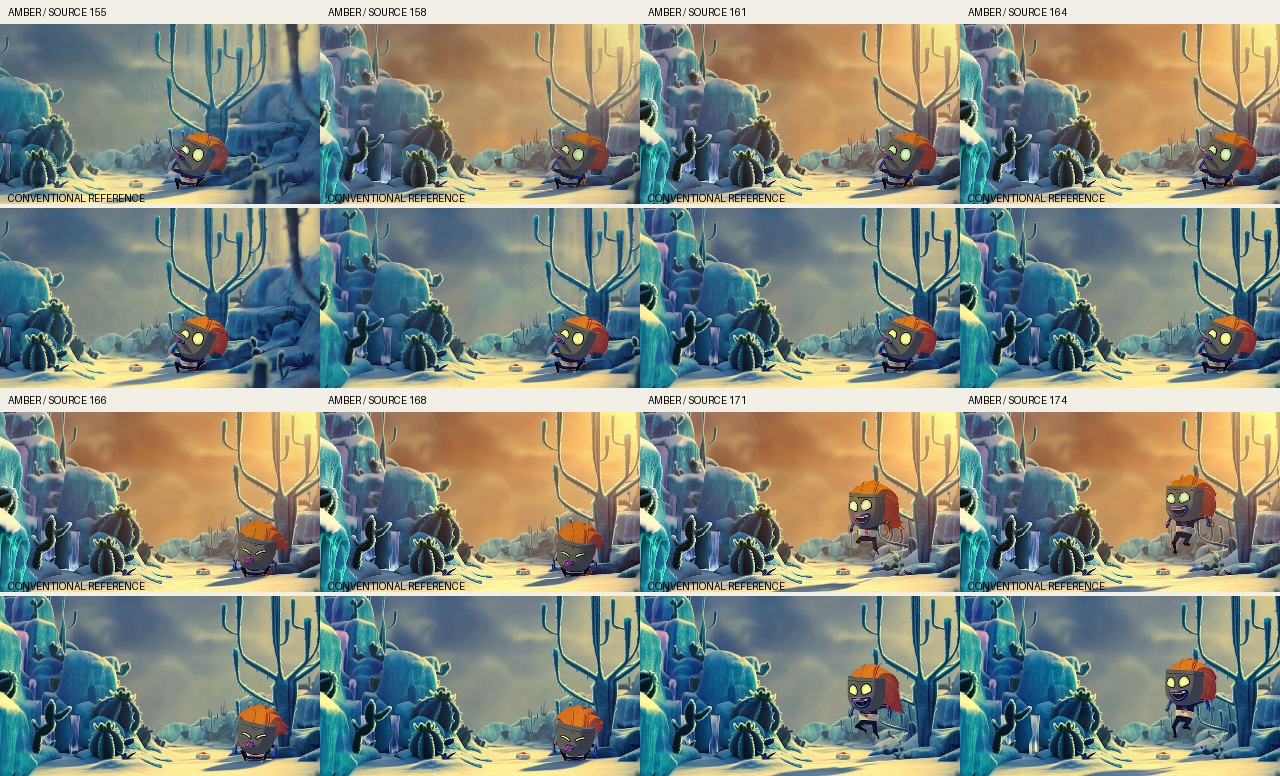
Two accepted generation jobs: 168 credits total (84 + 84). 248 credits remained after this stage; the later Spring study records the current balance. Two preflight validation rejections cost 0. Source: Settlers — Blender Studio / Blender Foundation, CC BY 4.0. Conventional guides by this project; generated video by Runway Aleph 2. Source and guide previews derive from 640×360 native renders; returned resolution does not add native source detail.
The world changes.
Does her action survive?
A previously unused three-second passage from Spring. The girl raises a hand to her mouth, lowers it, blinks and turns her head while holding a staff. Two consecutive model edits change the forest to ice, then amber dawn. The second uses the exact first returned video, with the original identity anchors supplied again.
The source and two candidate workflows are available as unlabeled A/B comparisons. No ratings or preferred answer are supplied. Record what survived and what did not, then reveal the methods.
Her performed moment.
Face, braided hair, red coat geometry, gesture timing, blink, head turn and hand/staff relationship.
A different world.
Glacial forest surfaces, then amber illumination on the character and environment. Original pixel colors are not required.
Human acceptance.
No independent response was available at publication. Author feedback and uninvolved review are recorded separately through involvement and prior-exposure questions.
Verified: both raw outputs fully decode 72 frames at 24 fps, exactly 3 seconds, 1920×804. The source is 1280×536; aspect ratio is retained. Two jobs cost 168 credits, leaving 80. No rerolls or repairs between calls.
Show labeled films and agent findings — review spoilers
The requested world changes are visible. The girl, hair and staff remain recognizable at sampled times; the hand-to-mouth gesture, blink and head turn broadly correspond. No gross identity replacement was identified in the declared samples. These are agent observations, not independent acceptance or exact all-frame equality.
The conventional alternative uses source-derived foreground masks on a generated frozen background, followed by fixed grading. It receives all-frame source information while the model receives five images. Approximate masks, edge blur, planar registration and lighting integration limit that reference. This is not a skilled-compositor benchmark or a physical relight.
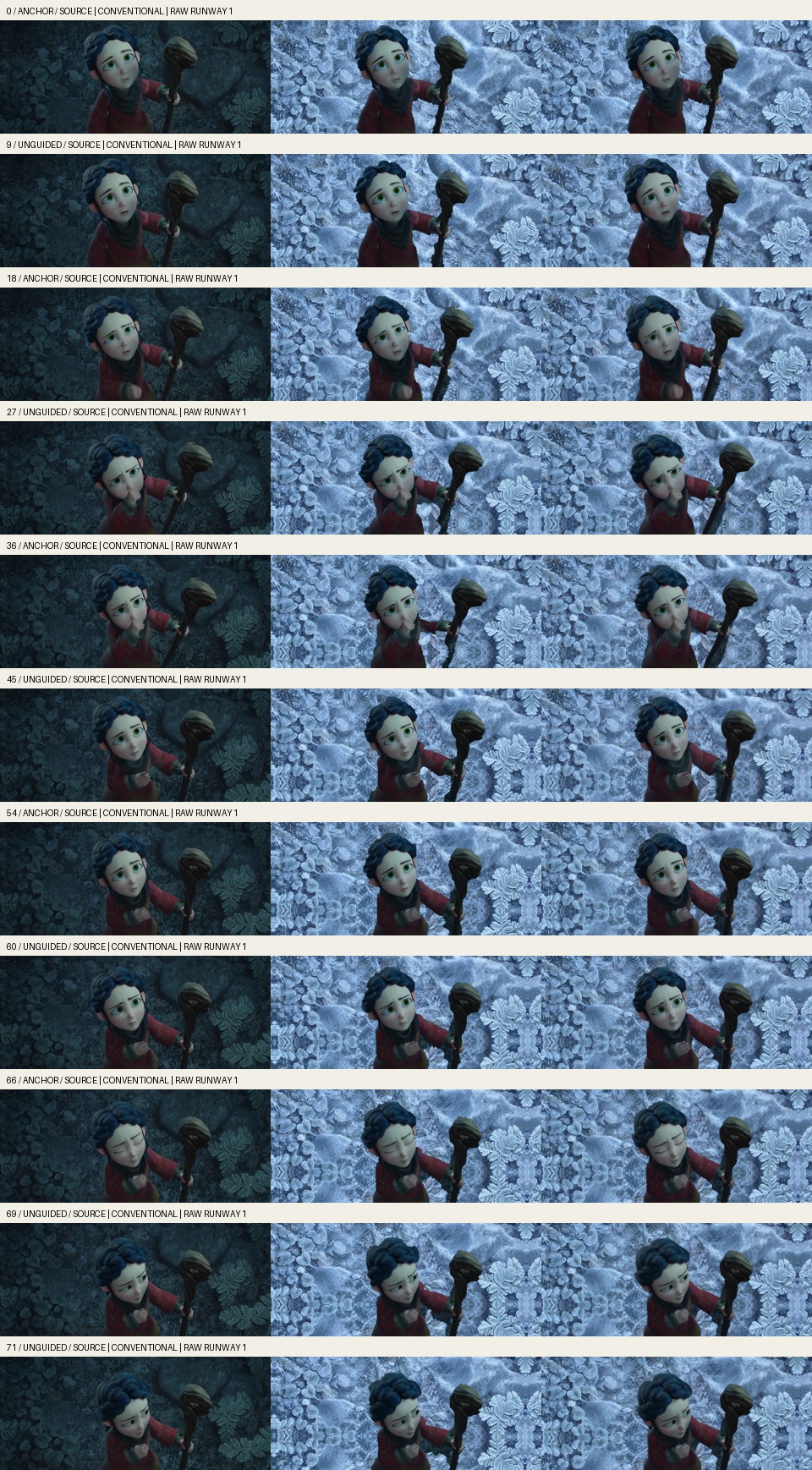
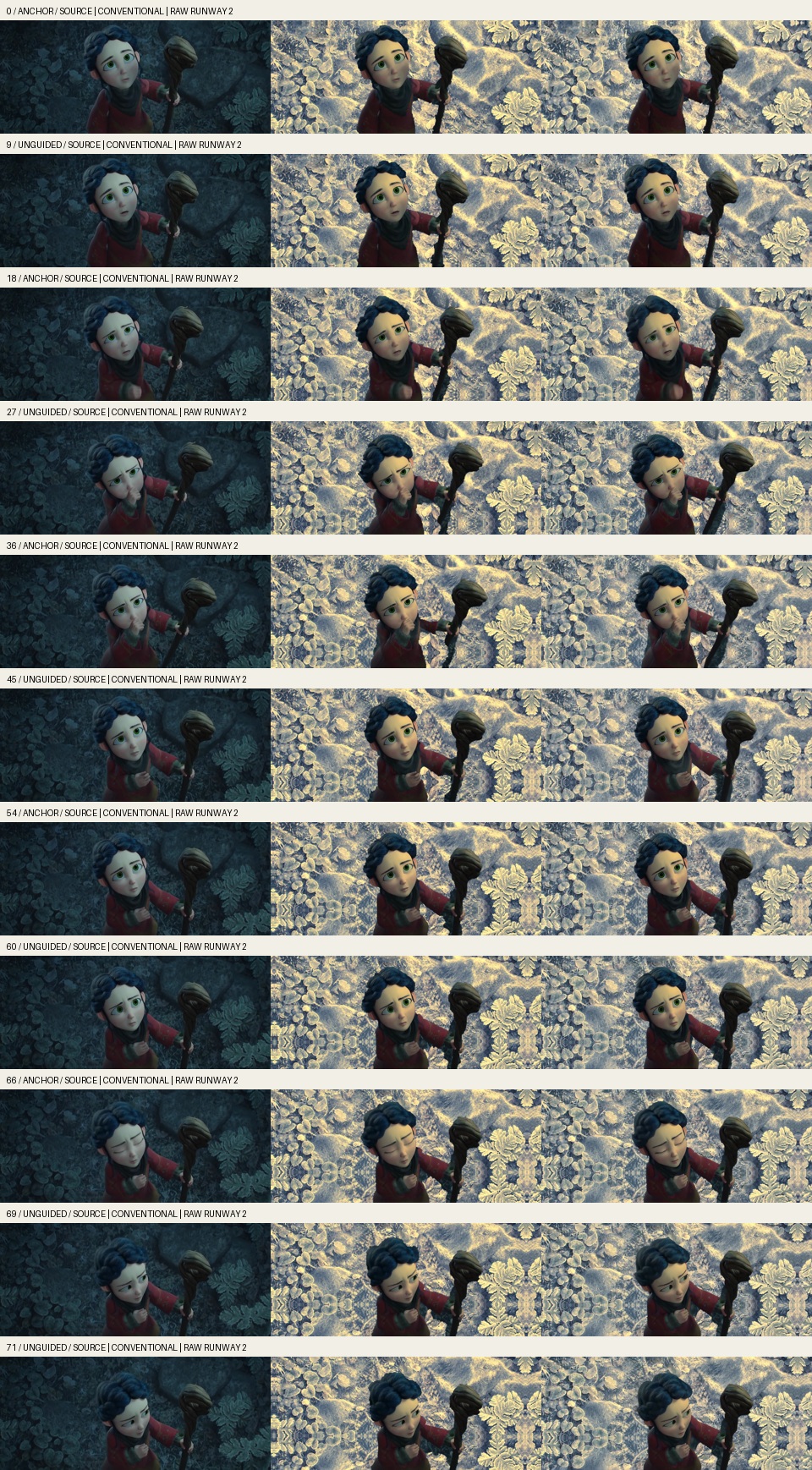
What makes this a new test? What changed in the method?
This Spring passage, 107.75–110.75 seconds, is outside the recorded monitoring-corpus ranges and was not used in Afterimage's earlier generative trials. The film itself was already in the research library. This is a new transfer check, not a globally unseen or randomly held-out benchmark.
It uses the same model, seed, five-guide structure and two-revision lineage. Source aspect, duration and semantic subject differ. The native masks used for Settlers are replaced by approximate image segmentation for Spring. A single generated frozen background supplies the look; source girl/staff pixels supply each guide. A preflight hair-mask defect was corrected before any video submission. All final guides and conventional reference films were frozen before the new outputs.
Fixed keyframes are at 0, 0.75, 1.5, 2.25 and 2.75 seconds. Aleph 2, SDK 5.20.1, seed 20261001, MP4, no range/aspect override, default moderation. The second input inherits the first output's resolution and compression. Model internals and exact stochastic replay remain uncontrolled.
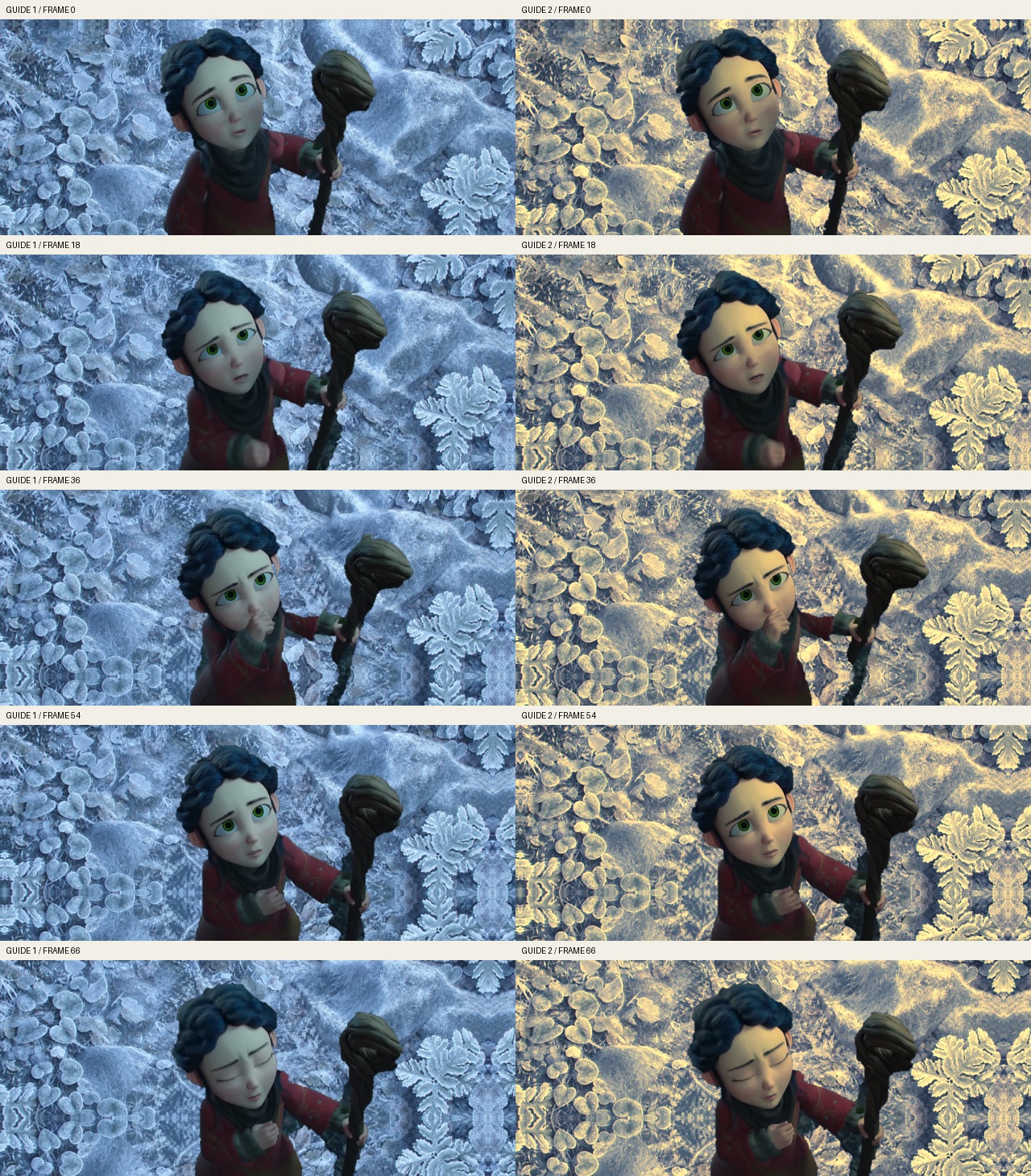
Spring (2019), Blender Animation Studio — © Blender Foundation | cloud.blender.org/spring · CC BY 4.0. Source project. One additional built-in image-generation call created the background plate, separate from Runway's balance. Original source unchanged. No audio in this visual comparison.
Earlier study / one revision, direct and coordinated repairs
Into the desert.
A different camera. A new placement. The same performed moment.
25–72 / NATIVE 24 FPS
Move the character one metre to camera-right. Orbit the camera from 12° to 24°. Make the character 35% larger in frame. Carry contact, attachments, performance timing and the selected composition through the edit.
Demonstration brief selected by the agent. Original work: Settlers, Blender Studio / Blender Foundation · CC BY 4.0.Source discontinuity: frame 42 / 0.708 seconds.
The frame monitor reports native evaluated geometry. The film remains the place to judge the work.
Several consequences.
One revision.
The lateral move remains one metre and the requested 12°→24° turn is retained around a fixed scene anchor. A foreground rock required moving the camera to 20% of its original orbit radius, with lens and shift adjusted to retain framing. Both repair methods receive that same camera path and a matching adjustment to the source foreground blur band.
The existing IK controls remain available; the selected path reports whether they needed adjustment. Head, hair and backpack must follow the character without separating. Terrain and occluders are evaluated at each frame.
Keep the source actor center within 3.5% of the frame, while enlarging its projected height by 35%.
| Check | Unrepaired | Direct | Coordinated |
|---|
One development passage. Frame counts are not independent trials. ¹Camera/lens steps are additional diagnostics, outside the original acceptance gates; lens continuity across the source jump is not established.
Hold the relationship.
Choose its priority.
Both policies keep contact, attachment, visibility and the substantive edit. The second may accept a reported frame-center deviation.
These controls inspect the evaluated alternatives. They do not launch Blender or manufacture new results in your browser.
What this establishes.
Awaiting native results.
What remains open.
Artistic improvement and reduced repair effort need independent judgment. The direct reference is an agent-authored conventional control sequence, not a skilled artist benchmark. Contact phases are provisional. Geometric visibility rays treat refractive surfaces as opaque; this is not optical visibility, full collision or a model of attention. The source changes world position abruptly at frame 42. A fixed orbit anchor prevents that jump from dragging the camera, but preserving framing can still change the lens at that boundary. All 48 consecutive frames are retained, including that discontinuity. This is two seconds from one development scene.
The scene. The decisions. The evidence.
The scene package will be labeled according to its verified dependencies.