USArray Transportable Array · Tōhoku Mw 9.0 + Japan 2021 Mw 7.1
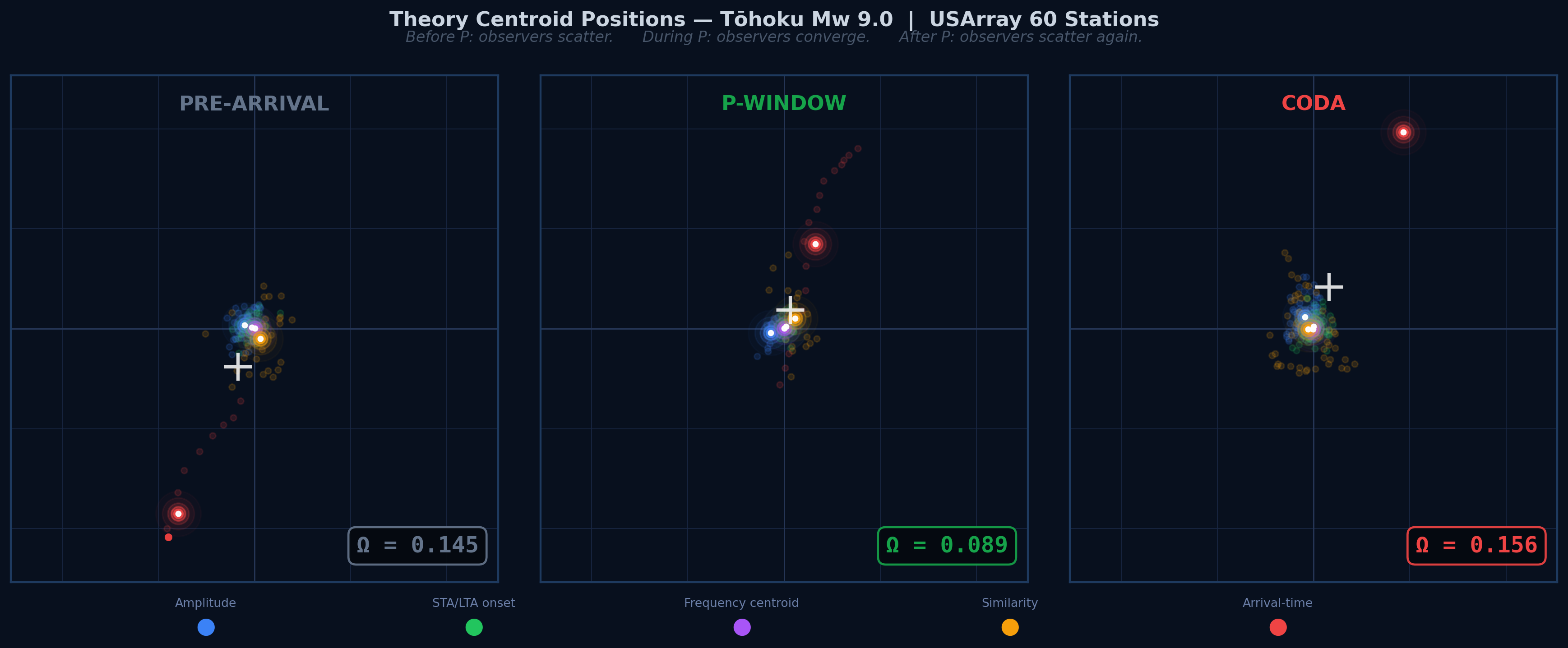
Ω collapses during P-window and expands again — reproducibly across opposite source geometries.
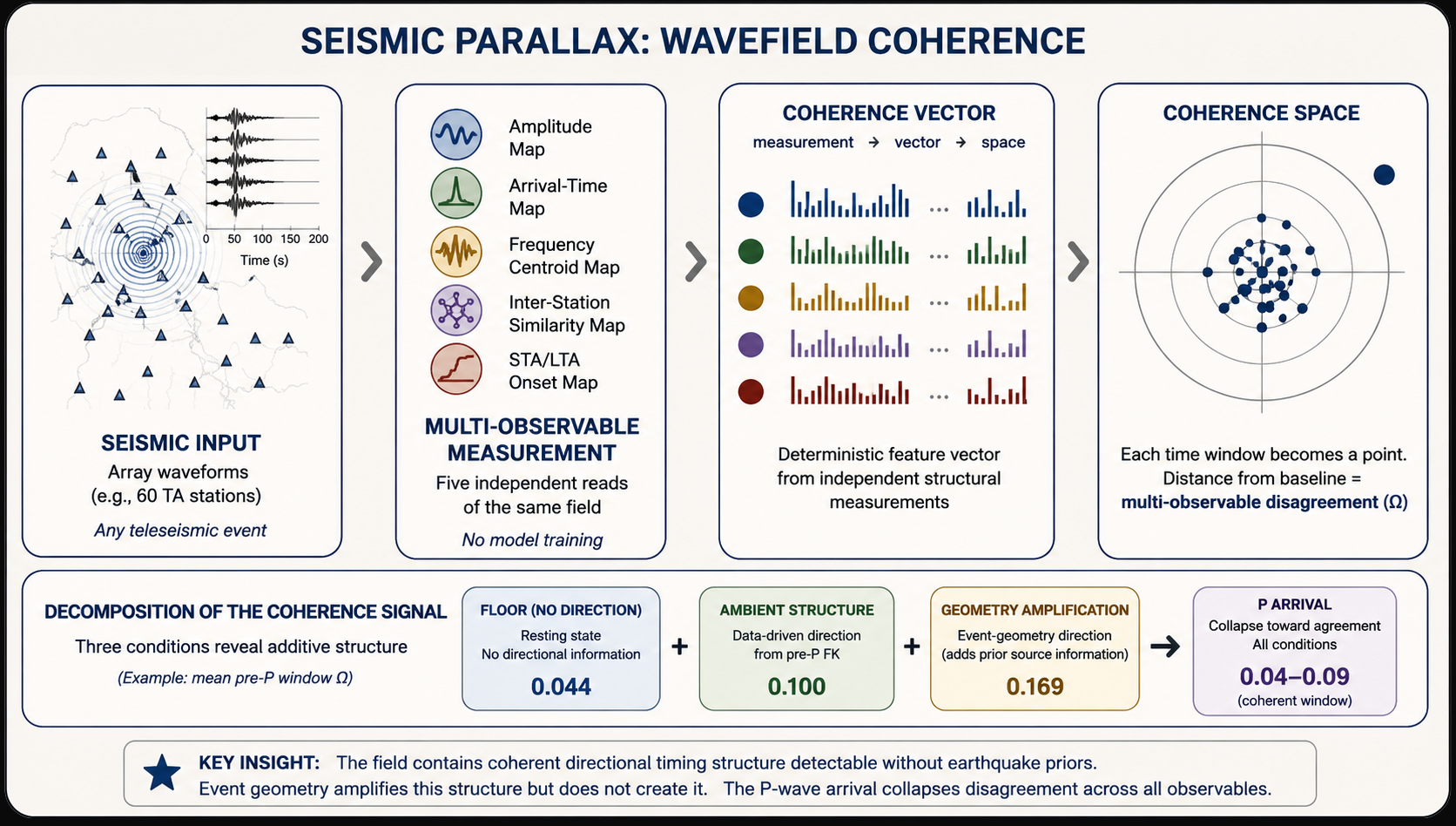
Two teleseismic events recorded across the USArray TA provide the primary Ω demonstration. Tōhoku (Mw 9.0, NW source) and Japan 2021 (Mw 7.1, same general geometry): in both events, pre-arrival Ω is elevated relative to the P-window, and coda Ω expands again after the direct arrival. The three-window structure — diverge, converge, diverge — is reproducible. The convergence during P is not a threshold crossing. It is a continuous structural collapse visible across all five theory pairs simultaneously.
Pre-arrival Ω (data-driven)
0.100
P-window Ω
0.075
Cohen's d (4/5 events)
1.78
Quiet-day floor
~0.040
IMS-Class Compact Arrays · PDAR, TXAR, WRA, NVAR · 15 FK Failure Cases
Coherent, confident, wrong — twelve cases where P was present but did not win.
Fifteen FK beamforming failures across four IMS-class compact arrays on two continents. Twelve cases: the direct P-wave was present above noise, physically real, energetically detectable — and FK chose a different coherent answer. The Japan 2021 / PDAR case is the canonical example: P present at 71% of peak power; FK back-azimuth error 59.7°. SNR did not flag these cases. Station-removal robustness testing reveals three structurally distinct failure families, each with different diagnostic signatures and different required remedies.
Total failure cases
15
P present but lost
12
Canonical back-azimuth error
59.7° (Japan 2021 / PDAR)
SNR discrimination
failed to separate families
Independence Experiment · Same Data, Different Theory Design
6.9× gain from physical independence — not from more theories, more data, or better math.
Five theories reading five different mathematical transforms of the same amplitude image: mean P/coda pairwise separation = 0.004. Five theories reading five genuinely different physical observables from the same wavefield: mean separation = 0.137. The gain is 6.9× under matched (data-driven) conditions. No new data. No parameter tuning. The entire gain came from replacing correlated mathematical transforms with physically independent observables. This is the central methodological finding: the degree of physical independence among theories is itself a measurable quantity, and it is the source of Ω's discriminating power.
Correlated transforms separation
0.004
Physical independence separation
0.137
Independence gain
6.9×
Data used
identical in both conditions
Ω Decomposition · 5 Events Spanning Mw 7.0–9.0
Three separable layers — ambient floor, timing structure, geometric amplification — all reproducible.
The pre-arrival Ω elevation decomposes into: a quiet-day floor (~0.040) present on days with no earthquake; an ambient timing layer (+0.060) recovered by FK beamforming on pre-arrival data without earthquake priors; and a geometric amplification layer (+0.069) added by event-geometry-informed arrival-time picks. The geometric layer does not create the pre-arrival signal — it amplifies a genuine ambient coherent structure approximately 2-fold. This decomposition is reproducible across five events covering winter and summer, NW and SE source directions, and a 2-order-of-magnitude range in moment magnitude.
Quiet-day floor
~0.040
Ambient timing layer
+0.060
Geometric amplification
+0.069 (~2×)
Magnitude range
Mw 7.0–9.0
The claim boundary, stated directly.
Ω is a diagnostic instrument, not a source-location algorithm. It does not replace FK beamforming, semblance, or array processing pipelines — it measures the structural conditions under which those pipelines are likely to produce unreliable answers. The FK failure cases are documented empirical examples, not a statistical sample from a known population; the three failure families are observational categories, not a complete taxonomy. The 6.9× independence gain is measured under specific data-driven conditions; the gain magnitude will vary with array geometry, event depth, and noise environment. The decomposition into three Ω layers is reproducible across five events at two arrays — broader replication across array types and tectonic environments remains the next required step. Ω outperforms mean pairwise cross-correlation (d = 0.17 → 1.78) and same-image Ω (d = 1.05 → 1.78) under matched conditions. The claim is structural field diagnostics and the coherence/correctness separation — not array processing replacement.
1.78
Cohen's d
vs. 0.17 for
cross-correlation
6.9×
independence
gain from physical
observable design
not a
locator
Ω measures field
conditions, not
source position