STUDIO RECORD / PUBLIC EDITION
Visual stages, comparisons and decisions from the original run. Internal prompts, operating documents and downloadable implementation files are omitted. Some interactive comparisons are shown as separate images.
htmlU03 — artist-led sittingU03 — artist-led sitting
Status: resource_checkpoint. Intermediate images are working states, not critic-approved results. Resource checkpoints are not artistic completion.
O — reading the set
Its interrupted lower field offers an unresolved relationship with consequences for the whole image: the foreground mass both belongs to and separates from the upright figure. Selecting it for development does not reverse its previous failed test.
Tension: The upright figure asserts continuity while the white interval interrupts possession of the foreground mass. External U03 offers a useful comparison in how a figure gathers from omissions, without requiring its arrangement to be preserved.
Open question: Can the separation become necessary to this drawing's particular presence, rather than read as either an anatomical mistake or an attractive gap?
1 — artist paint
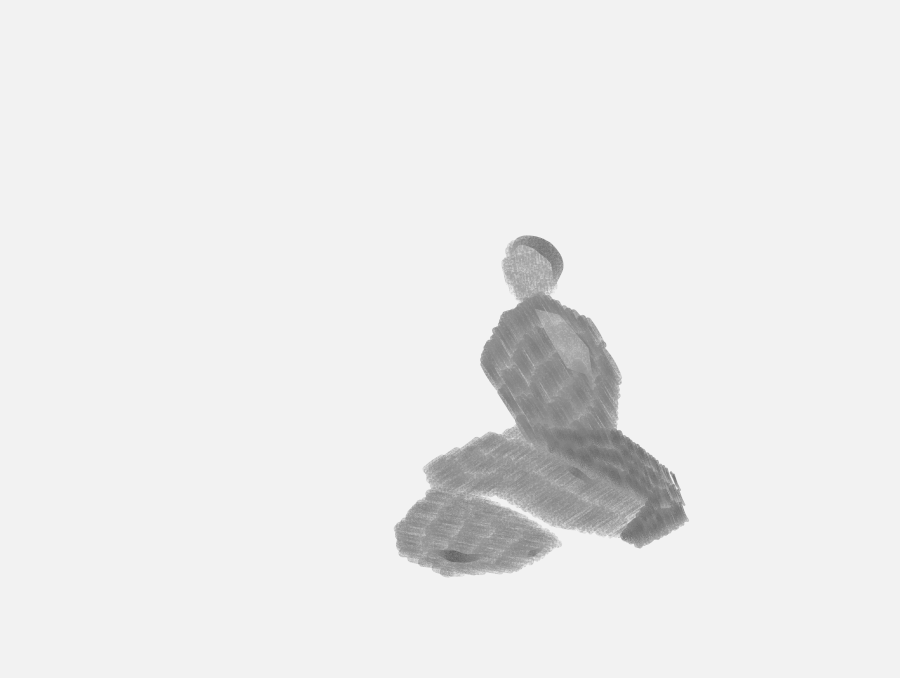
The white interval cuts diagonally between the detached foreground mass and the seated figure. Their similar charcoal bands make the separation more definite than either mass's character.
This is a foundation worth developing. I refuse the assumption that reconnecting the masses would resolve it; their uncertain belonging is the consequential possibility here.
Intention: Subtract some repeated bands from the lower torso into the lap, leaving a quiet passage. Deepen a short edge of the foreground mass facing the gap, then let that edge dissolve toward the left. Preserve the white interval while making its opposing shores unequal; observe whether separation begins to exert pressure on the upright figure.
2 — artist observe
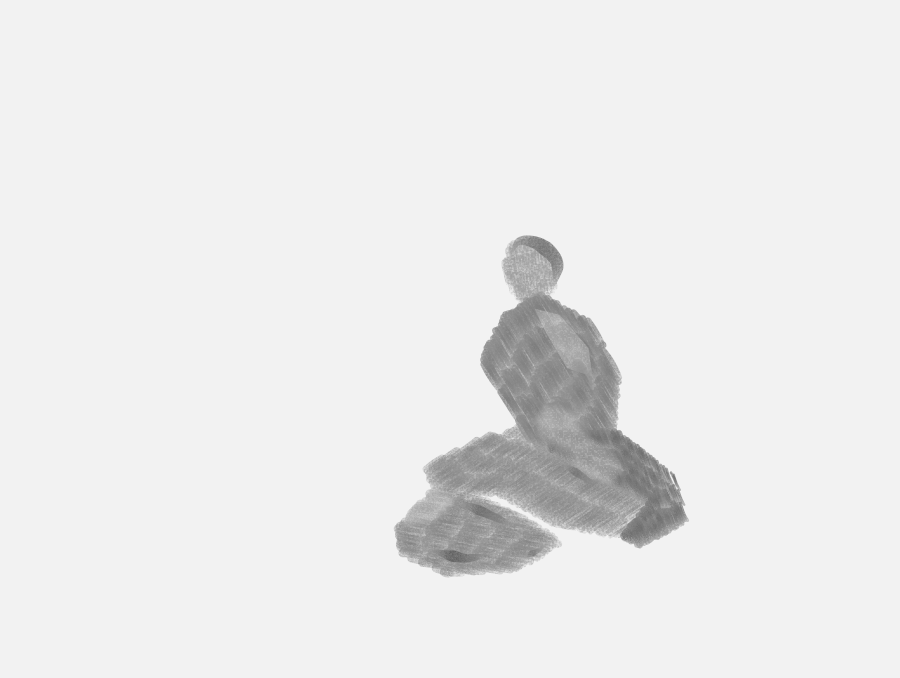
The lifted passage softens the torso's entry into the lap, but remains visibly patchlike. The new dark contact sits inside the foreground mass rather than firmly on its shore. White paper still separates the masses; the older lower dark mark now competes with the new one.
The test has only partly worked: unequal values have appeared, but the dark contact risks becoming the tapered accent the move meant to avoid. That failure does not invalidate the interrupted construction. Omega refuses to call increased contrast a necessary relationship; O can hold this distinction before another intervention.
Intention: Study whether the foreground mass can exert pressure through its extent and boundary, rather than another dark accent. Let the quiet passage remain provisionally awkward; the next construction should address how the lap approaches the interval without automatically closing it.
3 — artist paint
The lifted torso passage reads as a pale patch enclosed by charcoal. Below it, the white interval remains sharply continuous, while the two dark marks inside the foreground mass give that mass more internal punctuation than boundary resistance.
The accent test partly failed; the interrupted construction remains worth developing. Delta should change the lap's approach through subtraction. Omega refuses the assumption that the interval must remain uniformly open to preserve uncertain belonging.
Intention: Lift a passage from the pale lower torso through the lap's left-facing edge into the existing interval. Leave an adjacent blunt charcoal projection reaching toward the foreground mass without joining it. Let the opening enter the figure unevenly, sacrificing some of the lap's broad silhouette. Leave the foreground accents untouched for now and observe whether this altered boundary makes their direction consequential.
4 — artist paint
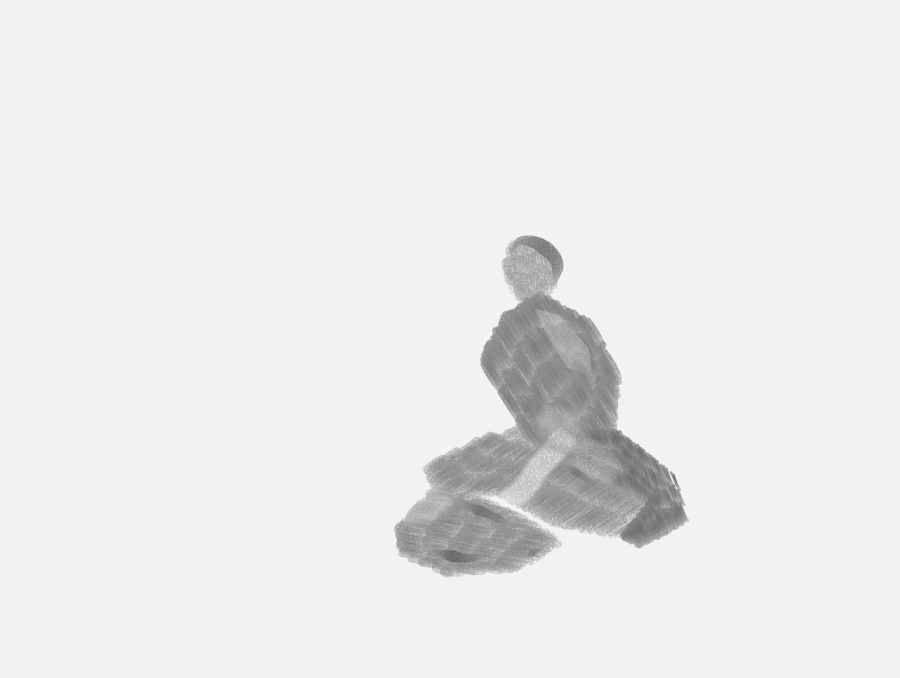
The new inlet connects the pale torso passage to the surrounding paper, but its narrow diagonal now reads almost as a bright limb laid across the lap. The foreground mass remains separate, with two dark internal accents. The upright body's repeated bands still give it more certainty than its interrupted lower extent.
The subtraction achieved continuity with the blank paper; its shape has not yet earned that emphasis. This is a partly failed test within a foundation worth developing. Omega refuses the assumption that making omission more conspicuous makes it more consequential.
Intention: Lift the lap immediately to the left of the inlet's lower mouth, widening that mouth into an uneven recess and sacrificing the blunt projection previously protected. Keep the inlet's upper reach quieter and narrower. Preserve the foreground mass for this move: let its upper extent face a broader absence, then observe whether the two internal accents still serve the drawing or merely punctuate it.
5 — artist paint
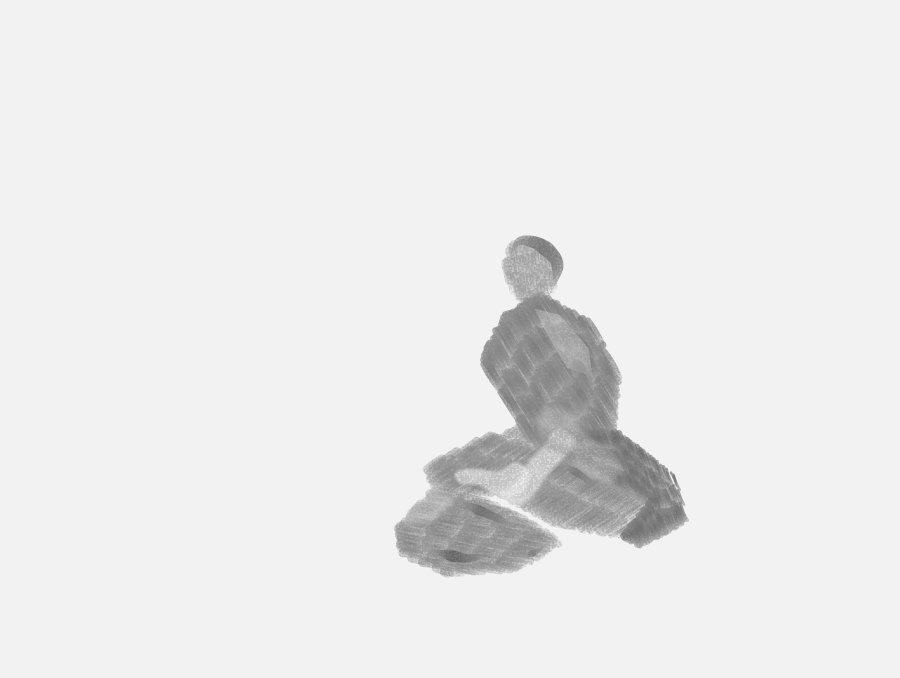
The widened mouth still reads as a pale bent limb across the lap. Its brightness organizes the lower forms more strongly than their uncertain separation does. Above it, the torso remains a closed, regularly banded mass; the foreground's two dark contacts remain isolated punctuation.
The recess changed the boundary but did not sufficiently interrupt the limb-like reading. That local test has partly failed; the separated foreground remains a foundation worth developing. Omega refuses the assumption that further refinement of this opening must carry the drawing's identity.
Intention: Lift a broad, uneven passage through the torso's left shoulder boundary, allowing surrounding paper to enter the upper mass. Retain a charcoal remnant between head and torso and the denser right flank. Leave the lap and foreground untouched. Test whether uncertainty can involve the upright assertion itself, rather than remain concentrated in a conspicuous lower opening.
6 — artist observe
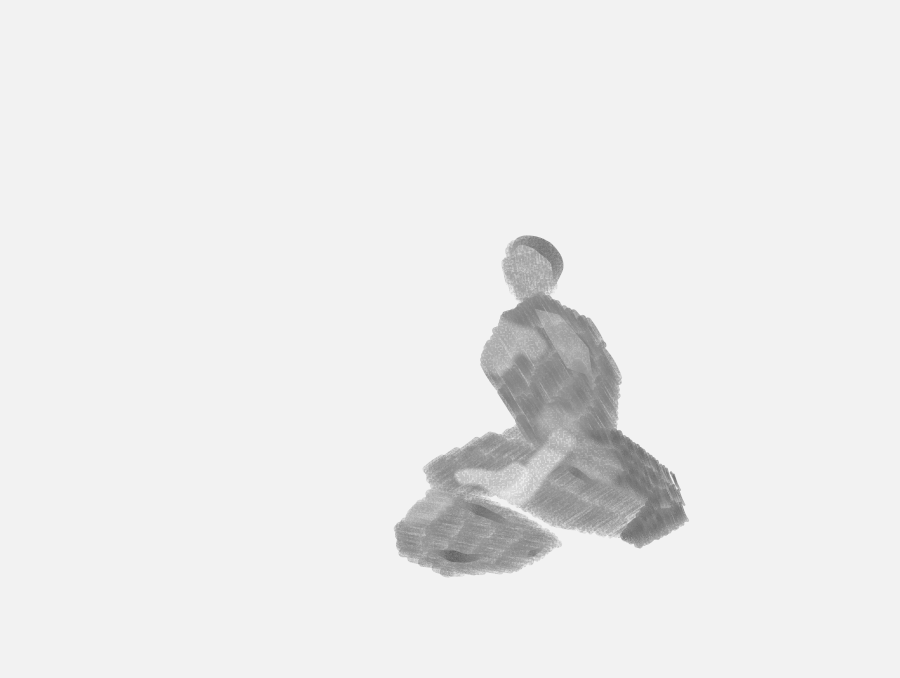
The shoulder lift interrupts the outer contour, but its scalloped pale edge resembles the bent pale passage across the lap. Dark bands still bind the torso's center and right flank. The foreground mass retains two small dark contacts, separated from the lap by a slant of blank paper.
The shoulder test opened the contour, but opening alone has not changed the drawing's governing relationship. Omega refuses to equate repeated erasure with active omission. O pauses to distinguish the useful separation from the emerging mannerism; this foundation remains available without declaring the recent tests successful.
Intention: Look at the blank interval together with the paper surrounding the figure, rather than as an isolated feature. Before another mark, determine whether the foreground's breadth or the torso's retained dark center carries the stronger resistance. Any next intervention should change that balance, without adding another pale bend.
7 — artist paint
The foreground mass spreads left beneath the upright figure, but its two dark contacts remain small and enclosed. The shoulder and lap lifts repeat pale bends; the torso's dark center still dominates both.
The separated construction remains worth developing, while the repeated pale passages have become a mannerism. Omega refuses the assumption that more subtraction will deepen omission. Delta can test the foreground's weight without repairing its belonging.
Intention: Lay a broad, unequal charcoal contact along part of the foreground mass's lower extent, merging the older lower accent into it. Let the contact disperse toward the left and stop before the right tip. Preserve the white interval and leave the upper accent exposed. Observe whether this lower weight makes the foreground resist the upright mass, or merely gives the detached form an emphatic outline.
8 — artist observe
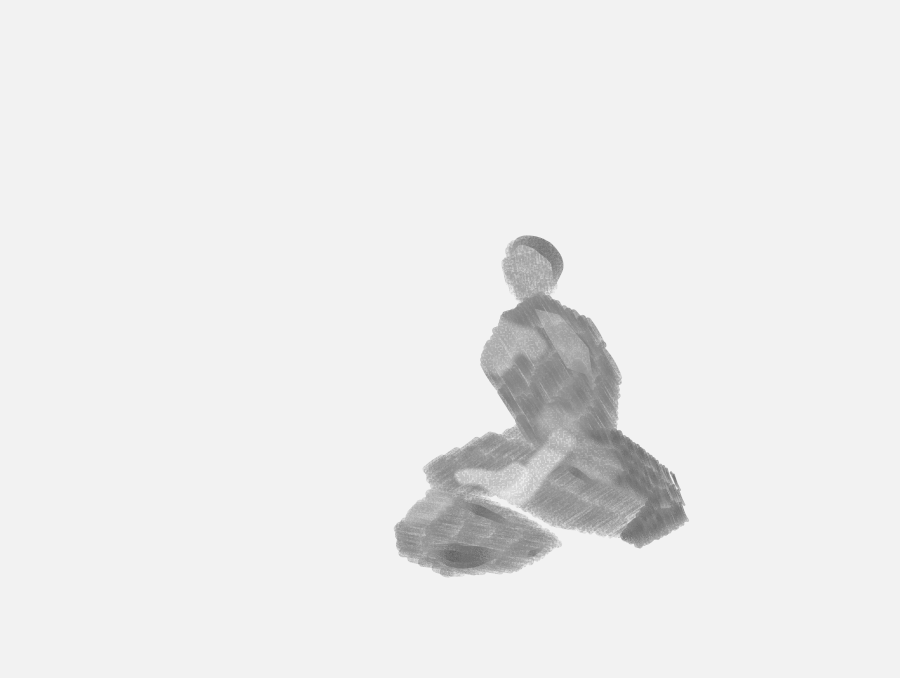
The lower deposit has merged with the older accent, but remains enclosed within the foreground mass. It gives that form a heavier underside without making its breadth challenge the torso. The upper accent and pale lap passage still direct attention along the white interval; the shoulder lift reads as a lighter shoulder more readily than an invasion of surrounding paper.
The latest contact partly succeeds as consolidation and falls short as lateral resistance. That does not defeat the foundation. Omega refuses the opening proposition's implied demand that the gap become necessary: the drawing may find its identity in unequal assertions of presence, with separation remaining an unresolved consequence. O should register this change before another correction.
Intention: Let the foreground rest. Consider a broader transformation of the torso's repeated bands into an unequal dark field, retaining the quieter shoulder as a weak boundary. Test whether the upright mass can acquire a particular pressure against the surrounding paper without relying on the head's recognition or another emphatic opening.
9 — artist paint
The foreground's heavier underside remains enclosed and subordinate. The pale shoulder and lap passages suggest bodily parts, while repeated bands give the torso an even certainty. The small head still supplies much of the figure's recognition.
The foreground contact consolidated a form without establishing the intended resistance. Keep that partial result. Omega refuses to make the gap prove the drawing; Delta can change the upright assertion itself without another conspicuous opening.
Intention: Work charcoal into a broad, unequal field through the torso's center and right flank, interrupting the repeated bands and absorbing part of the pale chest patch. Concentrate weight below the neck, then let it thin before reaching the lap. Retain the weak left shoulder boundary and leave the head and foreground untouched. Sacrifice some internal articulation; observe whether the mass gains pressure against the paper or merely becomes a darker silhouette.
10 — artist revisit
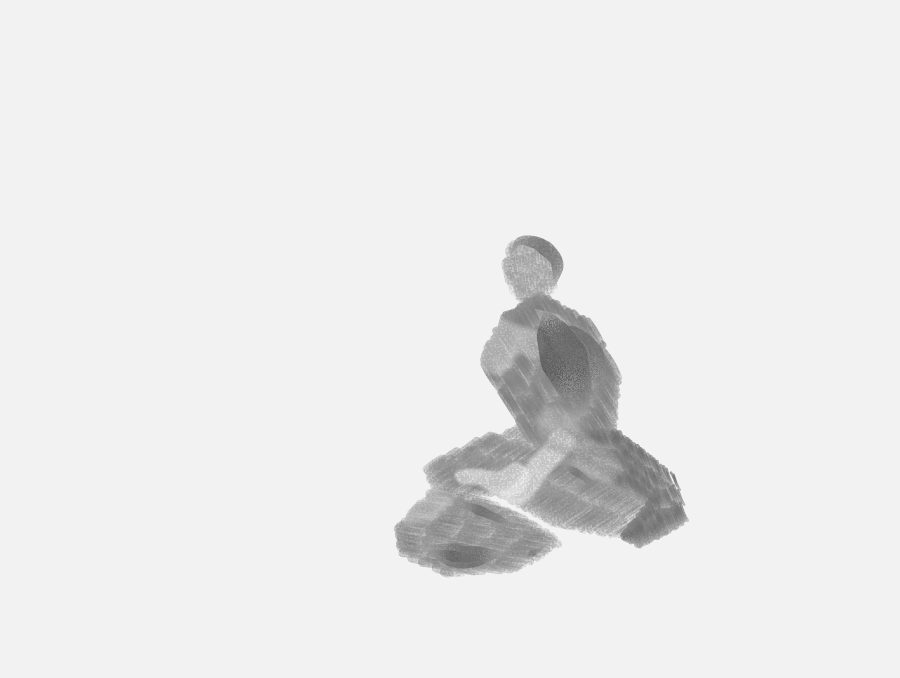
In sitting-009, the added charcoal forms a dark oval enclosed by the torso. The surrounding bands remain visible, so the deposit reads as an inserted part rather than a transformed field. Its rounded closure echoes the foreground's enclosed underside; the pale shoulder and bent lap passage remain explanatory.
This test failed to produce the intended broad transformation. I refuse to treat its darkness as progress merely because it is forceful. Returning to sitting-007 preserves the interrupted lower construction and accumulated decisions without committing the drawing to another enclosed accent.
Intention: Let the foreground rest. Change the upright mass through an intervention that crosses its right boundary into surrounding paper, with an unequal, broken extent. Sacrifice part of the existing silhouette rather than add another internal shape. Observe whether occupied space changes before asking the gap to carry further meaning.
11 — artist paint
The torso's right edge closes a banded mass above the dark lap tip. The pale shoulder and bent lap passage remain conspicuous, while the surrounding paper scarcely enters the upright figure. The foreground's heavier underside stays enclosed.
The enclosed oval in sitting-009 failed as a transformation, and the return preserves a usable foundation. Delta can now sacrifice containment. Omega refuses the assumption that crossing the boundary requires extending charcoal outward; subtraction can bring the surrounding paper into the mass.
Intention: Lift a broad, shallow, uneven passage across the middle right torso boundary, dispersing its inner edge into the existing bands. Retain separated charcoal remnants above and below the opening. Avoid a narrow channel or a smooth pale bend. Leave the head, lap and foreground untouched, then observe whether the remaining upright mass holds a changed relationship to the paper.
12 — artist observe
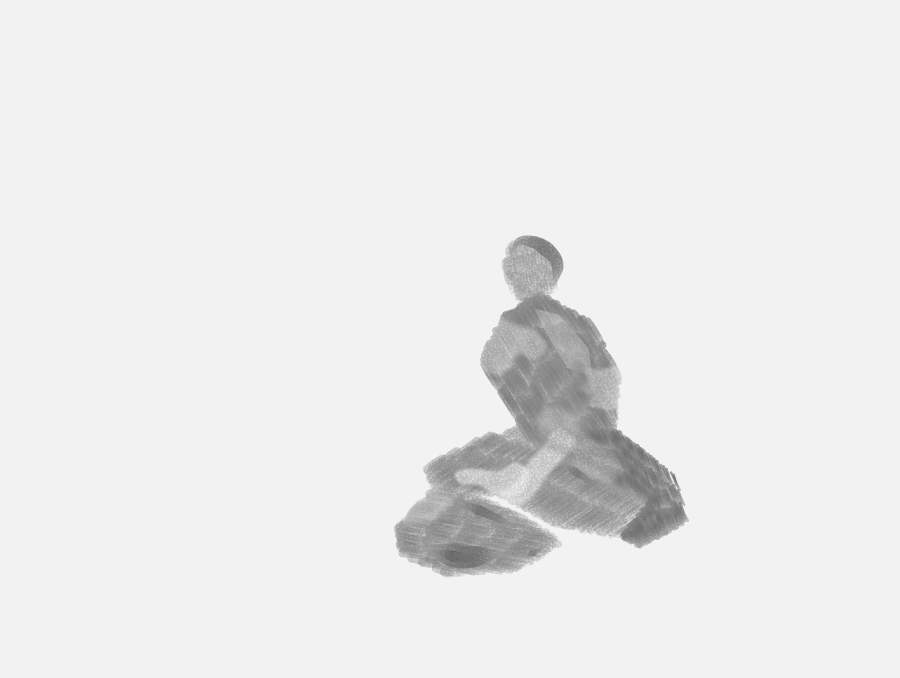
The right-side lift reads as a pale interruption within a still legible torso. Charcoal remains along its outer edge; surrounding paper has not clearly entered the mass. The shoulder, chest and lap now carry several light passages, while the foreground retains its enclosed dark underside.
The boundary test falls short of its intention. That does not require another immediate correction or invalidate the separated construction. Omega refuses the assumption that every omission must visibly open onto surrounding paper. O notices that repeated attempts to activate blank space have instead produced internal articulation.
Intention: Pause over the whole drawing, including its small occupation of the sheet. Consider whether the upright mass and detached foreground can sustain different degrees of certainty without further pale passages. Before painting again, identify one existing assertion worth strengthening or sacrificing; leave the latest lift unresolved.
Full decision and replay record