Visual stages, comparisons and decisions from the original run. Internal prompts, operating documents and downloadable implementation files are omitted. Some interactive comparisons are shown as separate images.
New: integrated runner and retained U03 sitting →
New: completed plane-building round and integration recommendation →
Keep the tones
the artist put there.
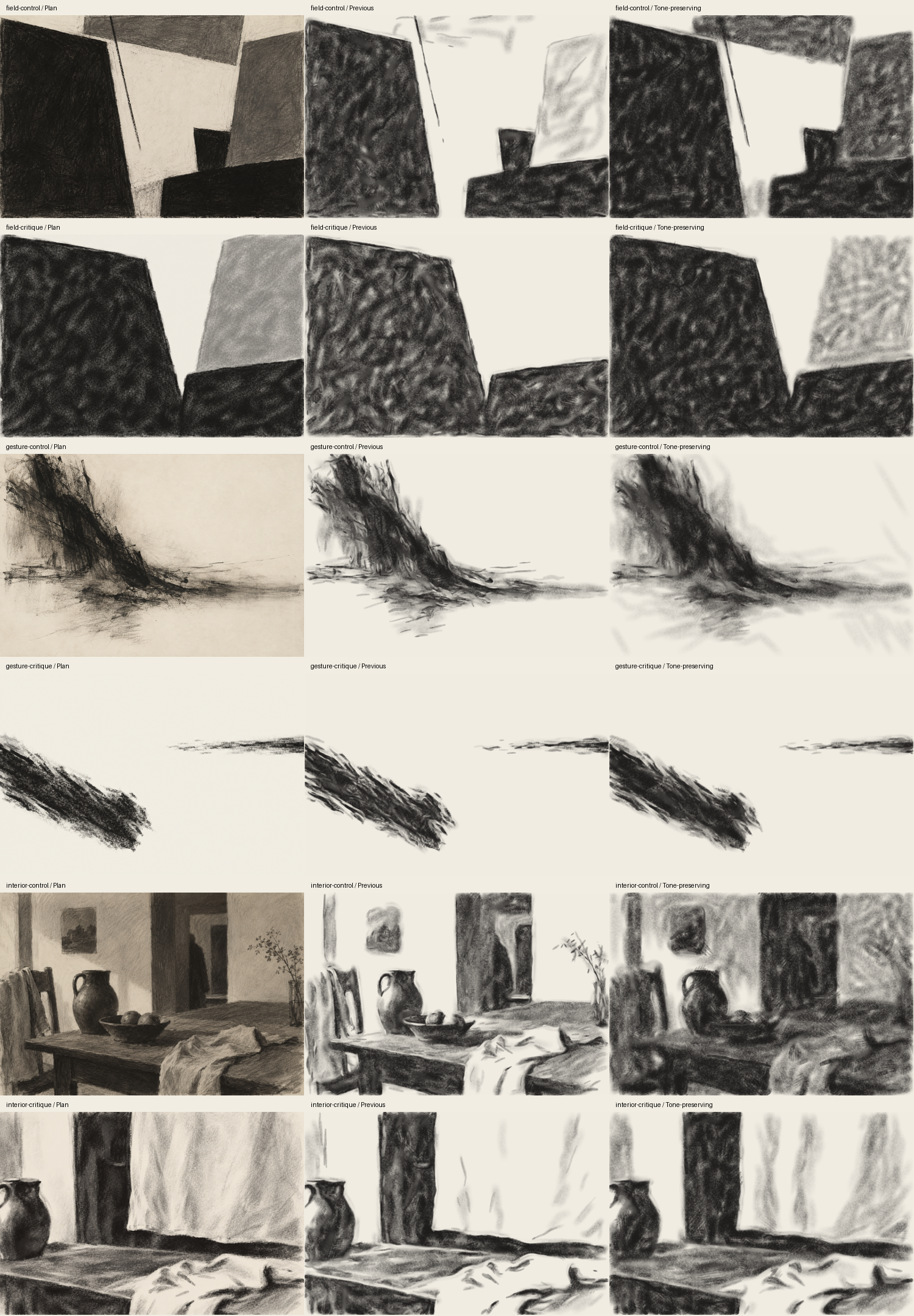
The same six plans, same seed, vocabulary, dimensions, planner settings and resource caps. Only the canonical tone conversion changes. Six new native results; all replay exactly.
Decision
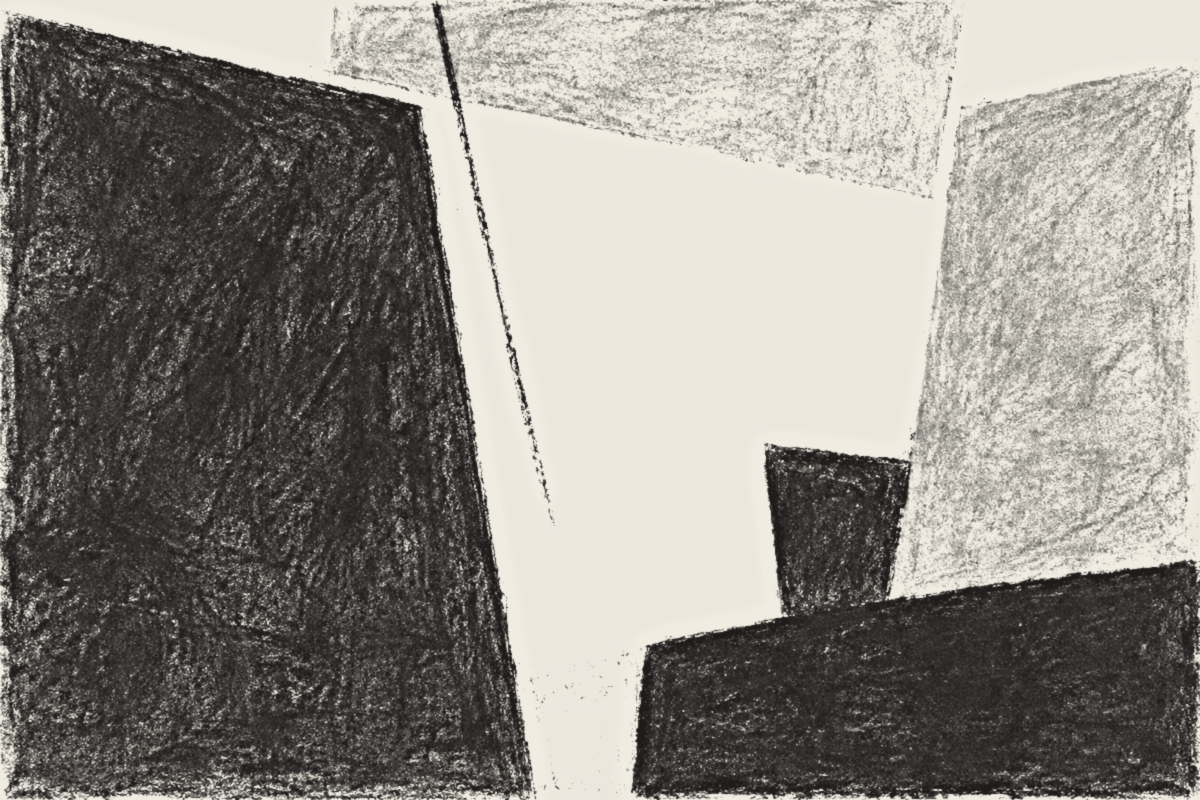
The correction is useful. Gray fields and the pale interior screen survive more clearly. All six results have lower error against the same tone-preserving target than the previous drawings, with reductions ranging from 25.4% to 84.9%. This measures target fidelity, not artistic quality.
The next limit is visible. Broad tones are still built as patches of short marks. The corrected conversion restores the requested tonal relationships but does not make flat fields flat, make a gesture unified, or decide which marks are necessary.
Use the explicit conversion for authored digital plans. Historical behavior remains available; no production defaults or old canvases were silently changed.
Compare plan and actual results
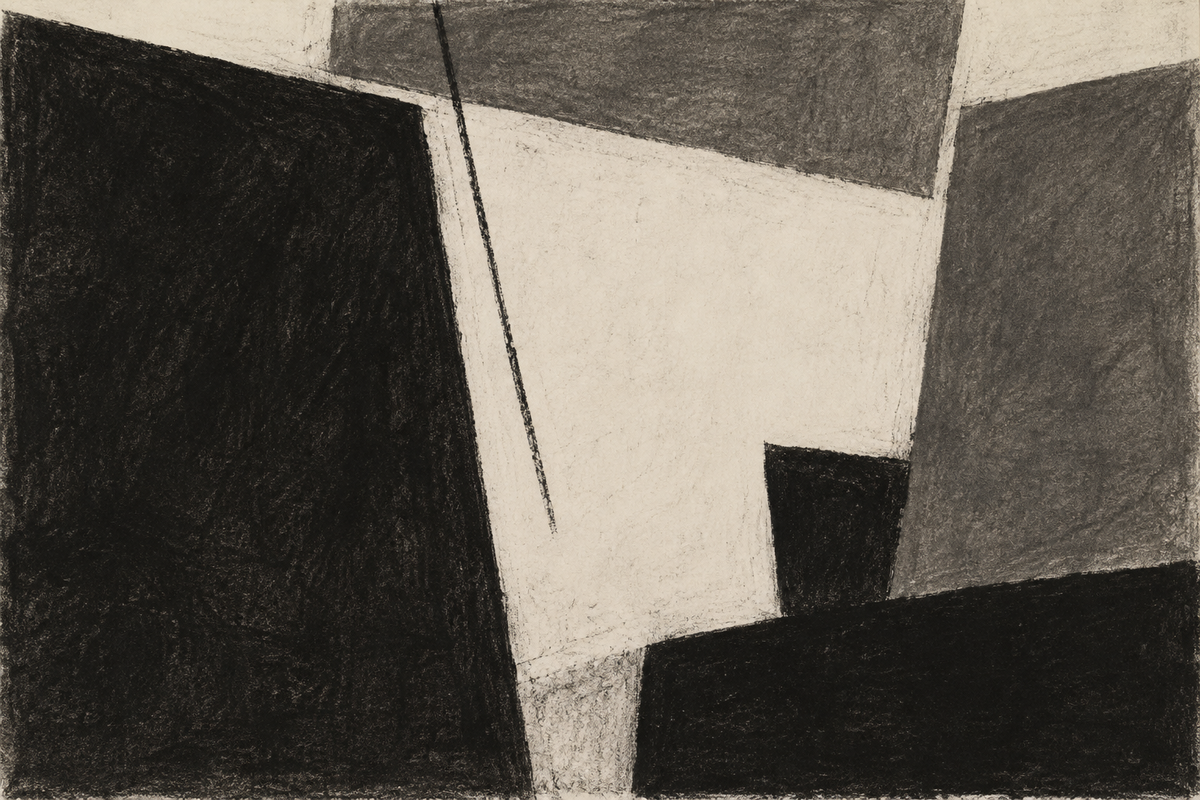
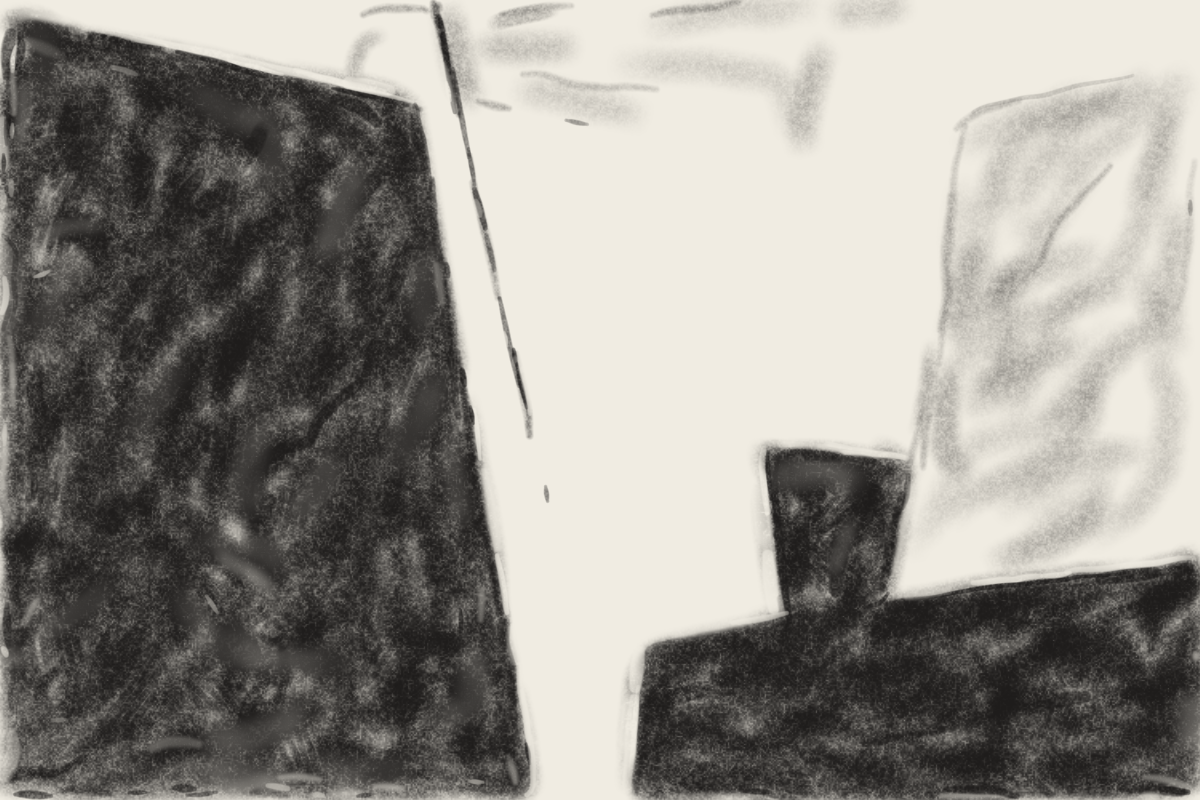
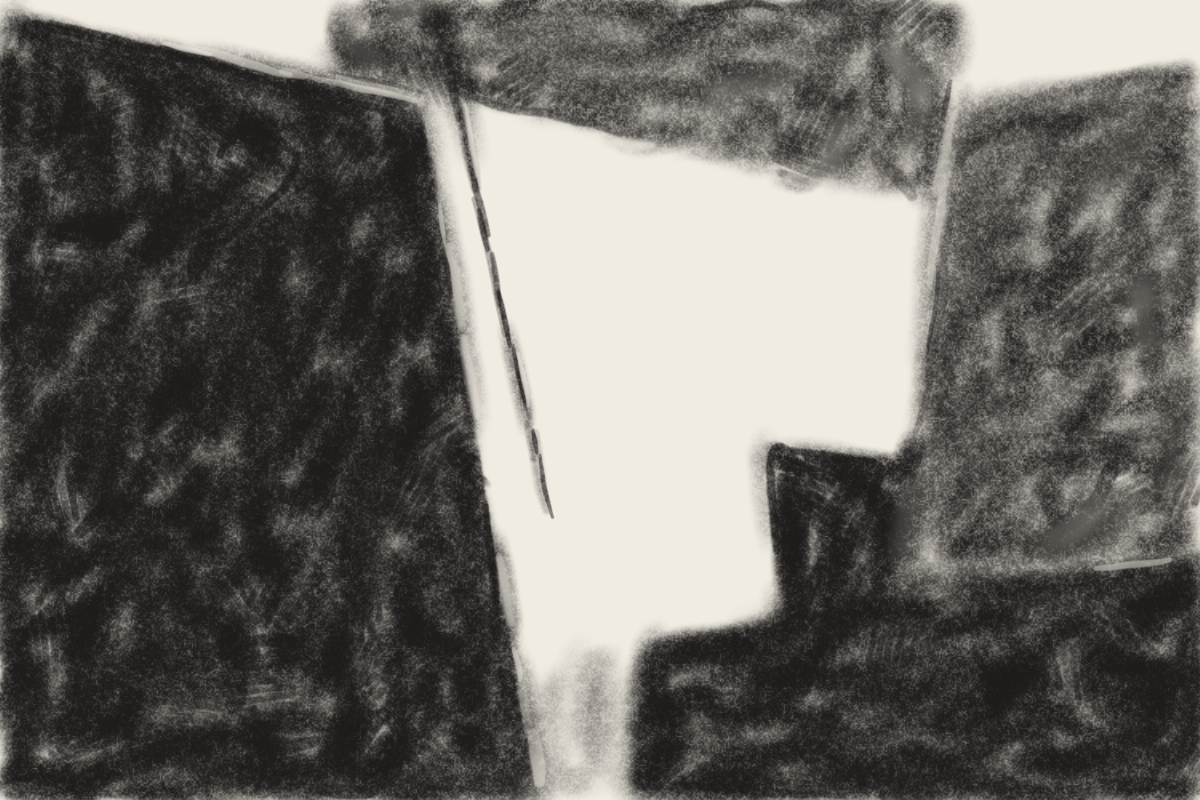
Inspect the target conversion itself
Tonal-scale calibration
Seven input grays: 30, 65, 100, 135, 170, 205 and 236. The legacy conversion collapses the last three patches to nearly the same tone. The explicit mapping keeps all seven ordered and distinct.


Tests also verify paper/ink anchors, transparency composited onto paper, the same swatch mapping identically in dark and light surroundings, and rejection of invalid dimensions or reversed anchors. .
Process and methods
- Reuse the six exact RGBA plans and local-view inputs from the transfer batch. No prompts or images are regenerated.
- Replace automatic paper inference with explicit medium anchors: paper RGB (240,236,226), ink RGB (30,28,27). Convert weighted display-space RGB brightness linearly into the medium's scalar interval, clamping only beyond the anchors.
- Do not stretch the image histogram, estimate paper from the 70th percentile, suppress paper stains or sharpen local contrast in this new canonical target.
- Render from a blank 1200 × 800 canvas with a 600-pixel planner view, seed 11, restraint 0.55, and the original 2,400-mark / 26,000-attempt caps. Actual accepted counts differ because targets and stopping behavior differ.
- Replay every new command stream exactly. Score both old and new drawings against the same new target, then inspect the full images.
This is display-tone preservation, not linear-light radiometry, perceptual colour matching or pigment physics. It maps colour into a neutral medium. Warm paper or stains may now demand marks; that distinction requires an explicit paper reference or mask rather than silently erasing pale tones.
The local planner's directional guidance still comes from the legacy look() analysis. The canonical target and its gradients used for scoring are replaced, but the whole perception pipeline has not been rewritten. That remains a possible contributor to handling limits.
Common-target evidence
Both columns below use the same fixed-anchor target for each pair. Old error numbers from the earlier batch used a different target and must not be compared directly with these.
| Plan | Previous MSE | Corrected MSE | Reduction | New marks | Replay |
|---|---|---|---|---|---|
| field-control | 0.09268 | 0.01403 | 84.9% | 972 | Exact |
| field-critique | 0.05125 | 0.01178 | 77.0% | 927 | Exact |
| gesture-control | 0.01624 | 0.00861 | 47.0% | 832 | Exact |
| gesture-critique | 0.00305 | 0.00228 | 25.4% | 1084 | Exact |
| interior-control | 0.08716 | 0.01404 | 83.9% | 1070 | Exact |
| interior-critique | 0.02338 | 0.00954 | 59.2% | 922 | Exact |
All six comparisons
Progress and remaining work
The original 30-output round is complete. This six-output correction batch is also complete. No new drawings were substituted into U03; it remains at its retained stage08.
Next recommended batch: compare broad-tone construction methods using these corrected targets, held fixed. The question is whether the instrument can lay a coherent plane without turning it into decorative texture. More artistic revisions would obscure that test.