Method, evidence, and limits

A claim should travel with its conditions.

Every result depends on a renderer, source field, preprocessing choice, metric implementation, resolution, sample interval, control space, and declared intention. This page separates what was measured from what was inferred.

Plain-language system map

From pixels to a directing decision.

ISR and VTL do different jobs. ISR turns a rendered frame into inspectable visual evidence. VTL measures relationships within that evidence. A controller then changes only the scene inputs it has been authorized to change.

01 · ISR

Build evidence from the image

ISR, the Image Structure Reader, derives fields from perceptual lightness, edges, slower tonal variation, chromatic activity, and gaps. Thresholds and masks turn those fields into regions that can be measured.

In ordinary language: it separates where visual activity is happening from where it is quiet, without first deciding that a region is a person, doorway, or story event.

02 · VTL

Describe the spatial relationships

VTL measures placement, void, packing, cohesion, boundary engagement, orientation, structural thickness, dispersion, G1–G4 behavior, color relationships, and selected composites. Across frames, it follows how those values travel, fluctuate, or settle.

In ordinary language: it can report that the frame’s structural center moved, that edges became more engaged, or that the organization changed less through time. It does not automatically know why that matters dramatically.

03 · Contract

Translate the director’s note

The original note is retained, then expressed as targets to pursue, protections that must remain within tolerance, observations to disclose, and free channels that may move.

This translation is a hypothesis, not a replacement for the note. The director judges whether the measured result actually fulfills the intended relationship.

04 · Controller

Edit, render, measure, repeat

The controller varies camera, lens, aim, blocking, light, material, or other authorized inputs. Blender or Unreal renders the consequence. Invalid candidates are rejected; valid alternatives guide the next local search.

The result remains an editable scene decision with its inputs and measurements attached—not a score pasted onto a finished movie.

One frame, traced end to end

What the instrument actually sees.

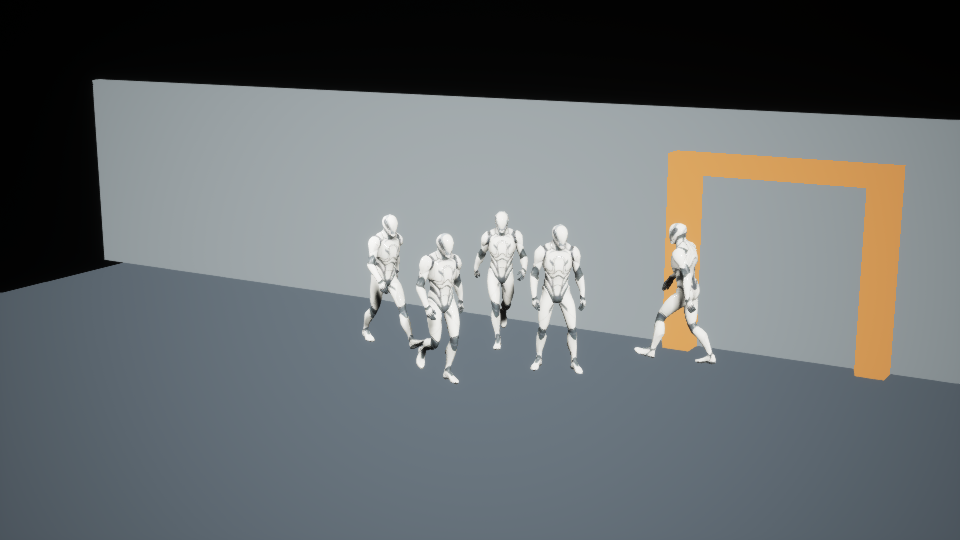
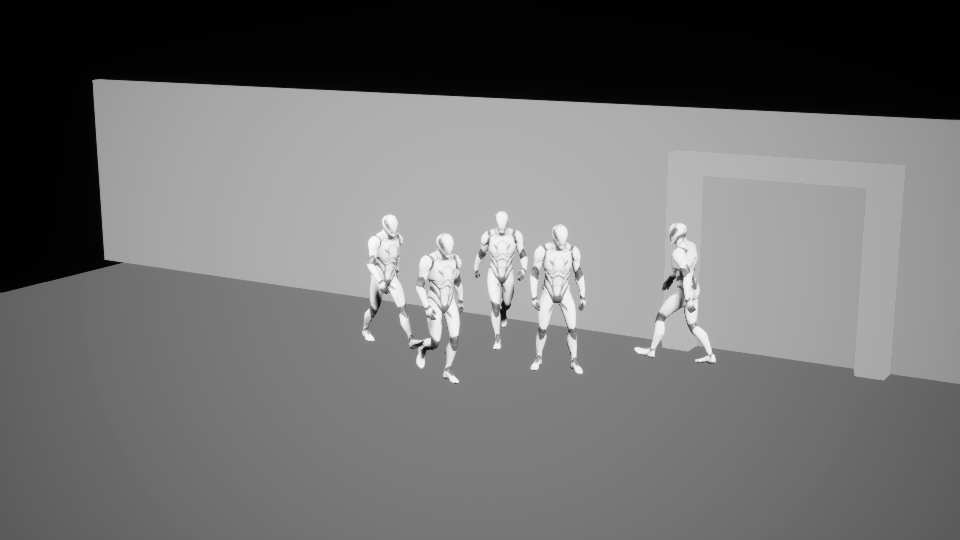
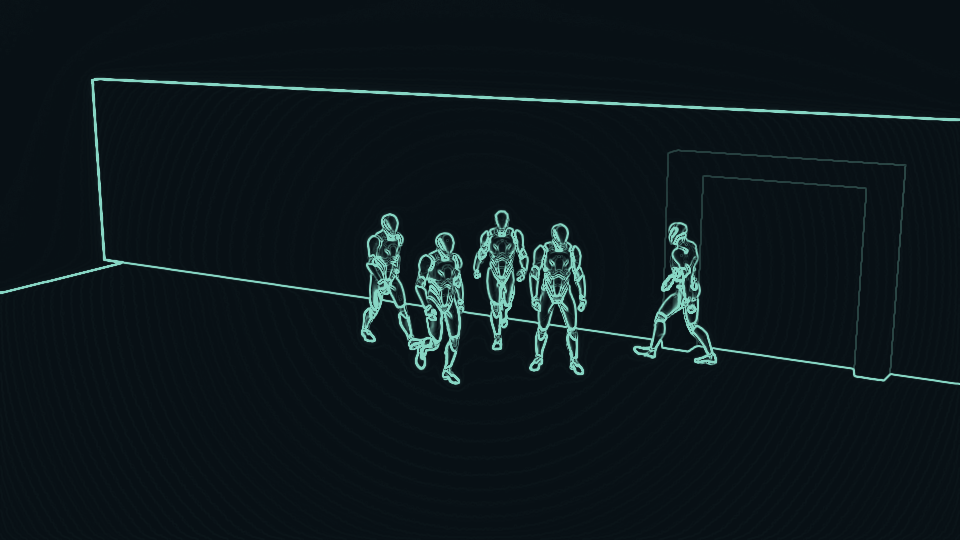
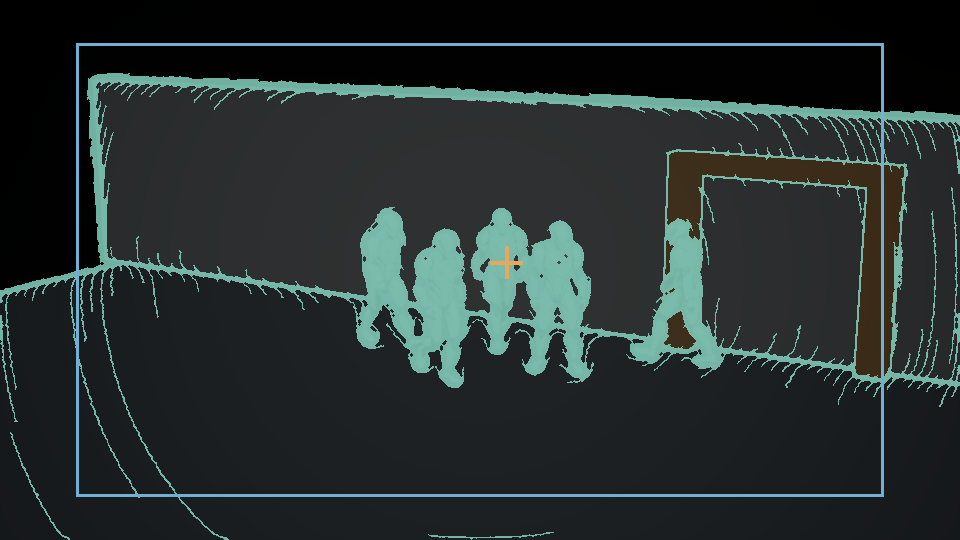
This is frame 24 from the retained five-character Unreal baseline. Every panel comes from that exact render using the implemented ISR lightness and edge fields plus the VTL structural mask. The plate is diagnostic output, not an artist’s reconstruction.

Unaltered Unreal render of five figures standing near a doorway
1 · Rendered consequenceThe image is the evidence. Camera metadata alone cannot predict how figures, architecture, color, and void combine on the surface.
Perceptual-lightness field derived from the Unreal frame
2 · ISR lightness substrateColor is converted into perceptual L*. This exposes value organization while leaving chromatic evidence available in a separate field.
Mint edge-activity field showing figures, architecture, floor, and doorway
3 · ISR edge evidenceBrighter mint marks stronger normalized gradient activity. Figure contours, the doorway, wall boundary, and floor transition all become measurable support.
Structural mask overlay with a blue peripheral-band boundary and amber weighted centroid
4 · VTL structural maskThe 85th-percentile mask selects structural activity. Blue marks the inner limit of the 8% edge band; amber marks the weighted structural centroid.
Δx+.0278

The structural center sits 2.78% of frame width right of center.

Δy−.0146

It sits 1.46% of frame height above center.

ρᵣ.1351

Active structure occupies a relatively sparse share of its convex hull.

μ.9844

Most selected pixels belong to one connected structural component.

xₚ.0426

4.26% of masked edge weight falls inside the outer 8% band.

θ.1243

Edge directions are broadly distributed rather than strongly concentrated.

dₛ.0075

The selected 2D structure is thin relative to the frame size.

SDI.1474

Masked mass has this normalized spread around its own centroid.

What it reveals

The center is only slightly right and high, with little structural weight at the frame boundary. ISR retains the figures and the main architectural relationships as one inspectable surface.

What it does not know

The high cohesion value does not mean “the family is united.” The wall, floor boundary, doorway, and figures form a largely connected mask. VTL reports that visual fact; character identity and dramatic meaning require scene data and interpretation.

How time enters

The same read is repeated across the shot. The temporal layer then compares paths, ranges, reversals, crossings, and total variation rather than pretending this one frame contains the whole beat.

Open the machine-readable provenance and complete coordinate record

What each layer can actually know

Image evidence and scene facts must not be confused.

LayerWhat it readsUseful translationBoundary
ISR evidence fieldsLightness, edge activity, broad tone, chromatic activity, gaps, masks, and connected regionsWhere the rendered surface is active, quiet, continuous, fragmented, bright, or chromatically distinctRegions are not automatically named characters, props, emotions, or narrative functions
VTL spatial coordinatesCentroids, void proportion, packing, cohesion, edge-band load, orientation, thickness, and dispersionWhere structure sits, how tightly it gathers, how it engages boundaries, and how stable its organization appearsA high or low value is not inherently better; the brief supplies the desired direction
VTL temporal coordinatesPer-frame paths, ranges, total variation, crossings, reversals, and changes across a sequenceWhether a visual relationship relocates, oscillates, accumulates, or remains settled while visible action continuesSampling is not eye tracking, and structural change is not automatically dramatic meaning
Scene and geometry checksActor roots and bones, projected figure scale, landmark visibility, camera state, animation, and scene identifiersWhether the doorway, witnesses, performance, scale, screen direction, or other production facts were actually preservedThese protections come from Unreal or explicit validation—not from VTL alone

Worked translation

One note becomes a measurable contract without losing its language.

“Keep the doorway and all three witnesses. Make the arrival split the group more decisively, but do not make the frame frantic.”
Keep the doorway and witnesses

This is a hard protection. Reject any candidate that crops the landmark, loses a required body, or breaks the requested geography. Evidence comes from projected scene geometry and visibility checks.

Split the group more decisively

This is the target. Search for a stronger change in group separation and temporal placement around the arrival, then inspect whether the render reads as the intended fracture.

Do not make it frantic

This is a restraint bundle. Bound edge pressure, center reversals, and unwanted temporal volatility rather than minimizing one universal score.

Preserve the performance

This is causal protection. Lock animation and actor transforms, then verify them across every sampled frame so the camera cannot borrow its result from changed acting.

The essential distinction

VTL does not “understand” the directing note by itself. It makes a proposed translation testable: the note remains primary, measurements reveal consequences, scene checks enforce facts, and human review decides whether the visual choice earns the language.

Closed-loop architecture

The instrument measures consequences, not commands.

1Director note

Desired relationship, protections, freedoms

→
2Candidate inputs

Camera, lens, aim, scene controls

→
3Native render

Perspective, bodies, architecture, light, void

→
4VTL readout

Coordinates, reliability, temporal paths

→
5Eligibility

Targets and preservation gates

↺

A kernel does not directly dolly or rotate a camera. The controller changes authorized inputs, the renderer produces the consequence, VTL measures that consequence, and the note determines which candidates remain eligible and where the next search begins.

Evidence discipline

Five forms of separation protect the claim.

Baseline remains visible

No-change is an alternative. Difference is not rewarded merely for being different.

Performance is locked

Unreal trials compare roots and named bones over every sampled frame, preventing camera results from borrowing altered acting.

Targets and protections separate

A coordinate may be pushed while scale, landmarks, visibility, or another channel stays within tolerance.

Metrics and interpretation separate

“Δx range increased” is a measurement. “The entrance feels disruptive” is a proposed reading requiring human validation.

Signal and render floor separate

Repeat renders establish the ordinary variation of each coordinate. A claimed effect must clear its own observed stability envelope.

Focused production calibration

How small a change can this test support?

This is a local stability check for the public Sprite Fright example—not a universal calibration of VTL. It uses the same renderer, shot, resolution, evidence substrate, and measurement code as the joint-directing result.

Repeat floor

Three matched frame pairs

Frames 103, 128, and 154 were rendered independently along the camera-only and joint routes before the blocking intervention began. Their parameters were identical.

Controlled dose

Four blocking degrees

At frame 256, the camera and performance were held while the lead rig stepped through 0.00, −0.25, −0.50, and −0.75 m on one world axis.

Decision rule

Detectable is not important

An adjacent step clears the local floor when its change exceeds three times the largest observed repeat difference. That supports detection only—not perceptual or dramatic value.

Channel0.00 m−0.25 m−0.50 m−0.75 mLocal result
Δx · horizontal placement−.0398−.0443−.0548−.0581Monotonic; every step clears floor
ρᵣ · packing.4496.4618.4722.4739Monotonic; response compresses at far end
μ · cohesion1.0001.0001.0001.000Saturated; unavailable for this local choice
xₚ · peripheral pull.0249.0252.0261.0264Small but above observed floor
SDI · dispersion.1550.1521.1464.1446Monotonic; every step clears floor
G1 path length.0640.0663.0695.0709Monotonic; every step clears floor
G1 reliable curvature.1559.1005.0822.0463Every step far exceeds .000035 repeat maximum

Useful: placement, packing, dispersion, and both G1 measures respond consistently to the blocking axis in this frame.

Diagnostic: cohesion is pinned at its maximum and cannot distinguish the alternatives. Structural thickness stops moving at the largest step.

Boundary: three repeat pairs and one scene axis do not establish a general noise distribution, a just-noticeable visual difference, or stable behavior in another renderer.

Open the sanitized machine-readable calibration

Claim ledger

What the work currently supports.

The table is deliberately conservative. A narrow claim that survives inspection is more useful than a grand claim assembled from suggestive labels.

Supported

Reproducible visual measurement

Exact renders, inputs, masks, coordinate versions, and selected outputs can be retained together.

Supported

Temporal structural description

Coordinate trajectories distinguish structural behavior from raw frame difference and visible movement.

Supported

Selective control within tested domains

Rendered feedback can find inputs that move a requested relationship while explicit protections remain within tolerance.

Supported

Joint native directing revision

The same note was realized through camera-led, blocking-led, and balanced routes while performance and required geography remained protected.

Supported

Persistent bounded revision

Three notes accumulated across one 16-second Unreal sequence while approved time ranges and untouched character and camera channels remained locked.

Supported

Independent production-scene transfer

A five-character Sprite Fright shot accepted two cumulative camera notes and one selective blocking note while the original source remained untouched.

Open

General dramatic semantics

No current test establishes that “suspense,” “release,” “disruption,” or “inevitability” transfers reliably across scenes or audiences.

Open

Autonomous intention or taste

The instrument does not infer whether an image was deliberately made, nor does it possess a validated independent aesthetic preference.

Open

Independent knobs

Camera and scene edits change a single projected surface. Coordinates couple, sometimes nonlinearly, and must be protected explicitly.

Open

Interactive note compilation

The current notes were encoded as experiment logic. A director-facing system that translates new language into safe, editable revisions has not yet been built.

Open

Human perceptual time

Scale-space paths and sampled frames are measurements of representations; they are not eye tracking or direct cognitive-duration measures.

Failures that improved the system

The useful mistakes exposed hidden assumptions.

Dark Classroom render

An engine conversion left 85.3% of pixels below 5% luminance. The resulting narrow classification was a render-validity problem, not a discovery about the scene. Preserving Cycles corrected it.

Lesson: renderer and illumination belong to the evidence contract.

Coupled scene endpoints

Peripheral and directional briefs reached their targets but converged visually because diagonal structure and figure placement were not protected.

Lesson: “leave the others alone” must become named tolerances.

Too-distant inevitable shot

The first branch reduced change partly by weakening projected figure scale, even though packing density looked acceptable.

Lesson: a plausible metric proxy does not replace the visual property actually requested.

G1 contradicted the dramatic shorthand

The disruptive shot had lower peak structural G1 than the inevitable shot while reorganizing more over time.

Lesson: within-frame scale-space stability and temporal reorganization are separate coordinates.

Repeat-render sensitivity

State-identical protected frames varied by only .067 of one 8-bit pixel level on average, yet threshold-based ρᵣ and μ moved as much as .0404 and .0437. The same audit found Δx stable to .0010.

Lesson: every coordinate needs its own observed render floor before a small effect is interpreted.

Reproducibility

The artifact chain remains inspectable.

Source state

Scene files, animation assets, exact frame ranges, and performance specifications.

Input state

Camera position, aim, lens, scene parameters, random seeds, and search domain.

Rendered state

Frame sequences, review movies, engine settings, resolution, and hashes where recorded.

Measured state

Raw coordinates, reliability and availability, temporal summaries, selection records, and warnings.

Promoted state

Native Unreal Level Sequences with animation, transform, and camera-cut audits.

Interpretive state

Original directing language, provisional coordinate translation, visual review, corrections, and claim boundaries.

Credits and version provenance

The evidence names what it depends on.

Attribution, software version, measurement layer, disabled systems, implementation hashes, and claim boundaries travel with the public artifact rather than depending on the development computer.

Production material

Sprite Fright · shot 010_0050_A

© Blender Foundation. Attribution: (CC) Blender Foundation | studio.blender.org. Project material is licensed under Creative Commons Attribution 1.0 except where specifically indicated otherwise.

Official license and attribution
Rendering environment

Blender 4.2.23 · EEVEE Next

Sequences: 960 × 402 at 32 samples. Matched hero frames: 2048 × 858 at 160 samples. Source files were never saved over; embedded production scripts remained disabled.

Evidence layers

Editable layer + full-frame check

The foreground RGBA render is authoritative for attributing camera and character changes. The presentation composite checks the visible whole frame. Scene geometry separately verifies named actors and clipping.

Instrument version

Adapted VTL/ISR implementation

Kernel and temporal-source hashes are recorded because historical notebooks with similar labels are not assumed numerically interchangeable. The public record contains no local machine paths.

Next development threshold

Compile a new note into a bounded revision.

Joint camera-and-blocking control and persistent scene history now exist in authored experiments. The next proof is operational: let a director issue an unscripted note, identify what it may change and what it must preserve, then return several editable Unreal revisions with their consequences and tradeoffs attached.

01

Protected timeline ranges

Approved beats become explicit intervals that later notes may read but cannot silently rewrite.

02

Writable-control permissions

The note declares whether camera, blocking, timing, light, or selected characters may change—and locks everything else.

03

Candidate revision families

The controller returns distinct causal routes, not one opaque winner, with render-floor-aware measurements and scene audits.

04

Production-fidelity coverage

Carry the loop into natural performance, multiple shots, screen direction, eyelines, and a higher-fidelity Unreal environment.

The decisive next test

Can a director give a note the experiment was not prewritten to expect, receive useful bounded alternatives, approve one, and then give another note without losing the prior choice? That would move the work from a sequence of proofs toward an actual directing instrument.

Return to the evidence