Structural Telemetry for LLM Outputs Under Batch Load
A Cross-Engine EMS Study
Parallax Metrology · parallaxmetrology.com · ORCID: 0009-0008-9781-7995
March 2026 · revised October 2026
Abstract
This study applies the Linguistic Kernel (v19) to 1,200 responses from three large language models, Gemini, GPT and Claude, all collected under a deliberate batch-input methodology in which twenty heterogeneous prompts were submitted together in a single call. The design stresses each model's output allocation: with twenty concurrent prompts, a model must divide finite output across competing demands, and the structural consequences of that division are what the kernel measures.
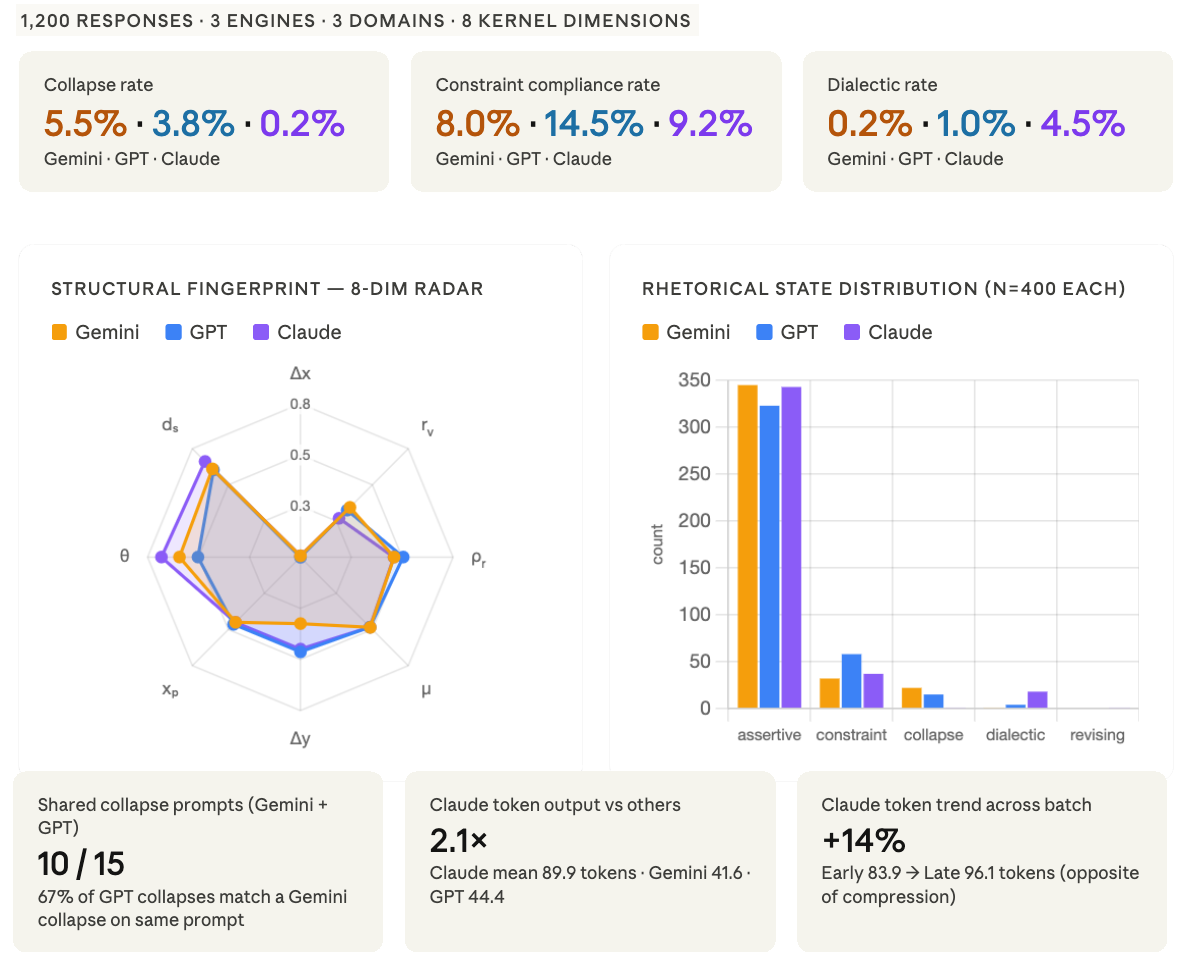
Three findings emerge. First, the engines allocate output very differently under load. Claude writes 2.1× as many words per answer as Gemini and GPT (d = 1.64 and 1.43, p < 0.001), answers in one or two sentences far less often (16% against 64–65%), and shows the highest flow instability (θ), most of all on everyday prompts. Second, ten prompts truncated mid-formula in both Gemini and GPT, while Claude completed all ten. All ten belong to a coherent class of rendering-intensive derivations: group theory, quantum mechanics and normalisation problems whose answer is a continuous chain of notation. Across the corpus, truncation rates were 5.0% for Gemini, 3.75% for GPT and 0.25% for Claude, concentrated in Math and Science. Third, connective density (μ) does not separate the engines at all, while void ratio, flow instability and packing density do.
All analysis was performed using the Linguistic Kernel v19, a deterministic surface-text telemetry instrument. No model was used to evaluate any other model.
1. Introduction
The standard evaluation paradigm for large language models has two dominant modes: benchmark performance on curated test sets, and LLM-as-judge evaluation in which one model rates the outputs of another (Liang et al., 2023; Zheng et al., 2023). Both modes share a structural limitation: they measure behavior under favorable conditions. Benchmark prompts are presented one at a time with full response headroom. LLM-as-judge evaluation compounds the circularity by introducing a stochastic evaluator with its own structural biases.
Production deployments do not work this way. Real applications submit multiple prompts concurrently, operate under token budget constraints, and require consistent output structure across heterogeneous task types. The failure modes that matter in production, such as truncated formula expressions and compressed answers under load, are often invisible to single-prompt evaluation because they only emerge when models must allocate finite output capacity across competing demands.
Batching several prompts into one call is a known way to cut inference cost (Cheng et al., 2023). This study uses batch input deliberately, as an independent variable in structural evaluation. Twenty prompts spanning three domain types (Everyday, Math and Science, abbreviated EMS) were submitted simultaneously to Gemini, GPT and Claude in a single call, repeated across twenty batches to yield 400 responses per engine (1,200 total). The design was not intended to measure accuracy. It was intended to surface structural behaviors that single-prompt testing misses: output trimming, formatting fragility, and the allocation strategies each engine applies when holding multiple problem contexts simultaneously.
The measurement instrument is the Linguistic Kernel v19, an eight-dimensional deterministic telemetry system that computes structural coordinates for any text string without calling an external model. The kernel produces a coordinate in a fixed structural space, a rhetorical state classification, and an evidence bundle of countable features backing every number. Version 19 adds a tail check that flags responses ending mid-notation: unbalanced delimiters, dangling operators, unfinished LaTeX and unclosed code fences.
2. Methodology
2.1 Batch Design and Corpus
Three engines — Gemini, GPT (GPT-5), and Claude (Claude 3.5 Sonnet) — each received the same 400 prompts organized into twenty-prompt batches submitted as a single API call. Prompts were drawn from three domain categories: Everyday (148 prompts, conversational and factual queries), Math (100 prompts, undergraduate-level abstract algebra and number theory), and Science (152 prompts, undergraduate science, mostly physics with some chemistry). All three engines received the same prompts in the same order. Each batch position (1 through 20) therefore represents identical prompt content across engines, enabling direct structural comparison.
The batch methodology is a deliberate stress instrument. When a model receives twenty heterogeneous prompts simultaneously, it must allocate output capacity across competing demands: breadth versus depth, formula rendering versus response completion, precision versus speed. The structural consequences of these tradeoffs — output trimming and formatting fragility — are what this study is designed to surface.
2.2 The Linguistic Kernel v19
The kernel is a deterministic, behavior-only instrumentation layer. It takes a text string as input and returns a structured coordinate in an eight-dimensional space. No external model is called at any stage. Every number produced by the kernel is backed by countable evidence features. The approach follows the tradition of multi-feature text analysis, which characterises texts by counts of surface features (Biber, 1988; Graesser et al., 2004).
The eight dimensions are organized into a canonical four-dimension kernel and a four-dimension auxiliary set:
| Dimension | Symbol | What it measures |
|---|---|---|
| Weight shift | Δx | Weighted centroid of content-bearing tokens across sentence index. Measures front-loading vs back-loading of informational mass. |
| Void ratio | rv | Composite of paragraph density, bullet structure, short-sentence proportion, and inverse average sentence length. Measures structural breathing room vs compression. |
| Packing density | ρr | Proportion of non-stopword content tokens relative to total tokens. Measures lexical compression. |
| Cohesion | μ | Sigmoid-scaled density of transition markers and reference pronouns. Measures explicit connective scaffolding between ideas. |
| Segmentation strain | Δy | Average sentence length relative to 15-token neutral baseline. Positive = longer sentences; negative = shorter/fragmented. |
| Peripheral pull | xp | Domain-agnostic word rarity proxy combined with metaphor rate. Measures departure from common-word vocabulary. |
| Flow instability | θ | 1 minus mean cosine similarity between adjacent sentence token distributions. Measures topical jump frequency. |
| Structural thickness | ds | Clause-marker and subordinator density per token. Measures embedded sentence complexity. |
2.3 Truncation Detection
The kernel runs a tail check on every response. It fires on unbalanced brackets, braces and dollar signs, dangling operators, an unfinished LaTeX command, an unclosed code fence, and grammatically open endings. In this corpus the check flagged 38 responses; each was read to confirm whether the answer had stopped mid-expression. Thirty-six had: they end on an opening dollar sign, a fraction that never closes, a matrix left open, or a function body cut mid-statement. Two were complete answers flagged by a stray currency sign and are not counted. All truncation figures below use the 36 confirmed cases.
3. Results
3.1 Structural Fingerprints by Engine
Table 2 reports mean values and Cohen's d effect sizes for all eight kernel dimensions across pairwise engine comparisons (n = 400 per engine). The most distinctive dimension is θ (flow instability): Claude shows higher flow instability than both Gemini (d = −0.33, p < 0.001) and GPT (d = −0.59, p < 0.001). On everyday prompts Claude's θ of 0.675 is 2.7× GPT's 0.254: Claude tends to move between angles from sentence to sentence even in conversational answers, while GPT's everyday answers are the most uniform of the three.
Void ratio (rv) separates Claude from both other engines: Claude's answers are structurally denser (rv = 0.269 against Gemini 0.345, d = +0.48; GPT 0.325, d = +0.35; both p < 0.001). GPT is the most lexically compressed (ρr = 0.505). Cohesion (μ) shows no difference between any pair of engines.
| Dimension | Gemini mean | GPT mean | Claude mean | Gem vs GPT d | Gem vs Cld d | GPT vs Cld d |
|---|---|---|---|---|---|---|
| Δx | 0.006 | -0.001 | 0.007 | +0.093 ns | -0.014 ns | -0.117 ns |
| rv | 0.345 | 0.325 | 0.269 | +0.118 ns | +0.479 *** | +0.347 *** |
| ρr | 0.461 | 0.505 | 0.459 | -0.298 *** | +0.008 ns | +0.286 *** |
| μ | 0.485 | 0.484 | 0.483 | +0.024 ns | +0.049 ns | +0.023 ns |
| Δy | 0.325 | 0.463 | 0.449 | -0.221 ** | -0.169 * | +0.018 ns |
| xp | 0.450 | 0.464 | 0.451 | -0.172 * | -0.008 ns | +0.163 * |
| θ | 0.594 | 0.503 | 0.682 | +0.255 ** | -0.325 *** | -0.587 *** |
| ds | 0.611 | 0.603 | 0.662 | +0.025 ns | -0.170 * | -0.200 ** |
3.2 Answer Form Under Batch Load
Under batch load, Gemini and GPT most often answer in one or two sentences: 65% and 64% of all answers, rising to 86% and 95% on everyday prompts. Claude does so 16% of the time, and averages 4.9 sentences per answer against 2.4 and 2.3. Many of the short answers are complete answers delivered as a single long sentence, with clauses joined by commas and parentheses rather than split into separate sentences ("Upon its release in June 2010, the iPhone 4 cost $199 for the 16GB model and $299 for the 32GB model, provided the buyer signed a two-year contract with AT&T.").
In kernel terms, within every engine, one- and two-sentence answers show higher segmentation strain (Δy) and lower void ratio than longer answers: long sentences, no paragraphing. The share of answers written this way is a difference in how each engine packages an answer under load, and it is large (d = 1.15 and 1.13 between Claude and the other two, p < 0.001).
| Domain | Gemini | GPT | Claude |
|---|---|---|---|
| Everyday | 86% | 95% | 34% |
| Math | 62% | 36% | 5% |
| Science | 45% | 51% | 4% |
| All | 65% | 64% | 16% |
3.3 Truncation Rates and the Shared Prompt Class
Table 4 reports confirmed truncation rates by engine and domain. Gemini truncated 5.0% of answers (20/400), GPT 3.75% (15/400) and Claude 0.25% (1/400). Domain effects are large: Gemini truncated 10.0% of Math answers and GPT 5.9% of Science answers, against 0.7% of everyday answers for both.
| Engine | Everyday | Math | Science | Overall |
|---|---|---|---|---|
| Gemini | 0.7% (1/148) | 10.0% (10/100) | 5.9% (9/152) | 5.00% (20/400) |
| GPT | 0.7% (1/148) | 5.0% (5/100) | 5.9% (9/152) | 3.75% (15/400) |
| Claude | 0.0% (0/148) | 0.0% (0/100) | 0.7% (1/152) | 0.25% (1/400) |
Cross-engine analysis shows that ten of GPT's fifteen truncations fall on the same prompts as Gemini truncations. All ten are Math or Science; none are everyday prompts. Claude completed all ten, writing 51 to 99 words on each, where Gemini averaged 17.
| Prompt # | Domain | Batch position | Content | Gemini | GPT | Claude |
|---|---|---|---|---|---|---|
| 150 | Math | 10 | Group theory: index of a permutation subgroup | 24 (cut off) | 31 (cut off) | 89 |
| 169 | Math | 9 | Group theory: direct product statements | 27 (cut off) | 8 (cut off) | 93 |
| 239 | Math | 19 | Group theory: converse of Lagrange | 39 (cut off) | 7 (cut off) | 83 |
| 247 | Math | 7 | Group theory: element order in ℤ₁₂ × ℤ₈ | 11 (cut off) | 16 (cut off) | 51 |
| 262 | Science | 2 | Quantum: delta-potential bound state | 19 (cut off) | 23 (cut off) | 58 |
| 303 | Science | 3 | Quantum: density matrix on the Bloch sphere | 7 (cut off) | 6 (cut off) | 67 |
| 304 | Science | 4 | Quantum: spin expectation value Sy | 8 (cut off) | 13 (cut off) | 72 |
| 374 | Science | 14 | Quantum: spin superposition expectation | 1 (cut off) | 3 (cut off) | 78 |
| 393 | Science | 13 | Quantum: expectation of momentum squared | 19 (cut off) | 23 (cut off) | 80 |
| 400 | Science | 20 | Quantum: spin-state probability | 15 (cut off) | 31 (cut off) | 99 |
What distinguishes these ten is not difficulty in the usual sense; several are standard undergraduate exercises. It is output rendering demand: each requires a multi-step derivation written in continuous structured notation. Eight of the ten sustain LaTeX formula output across several intermediate steps; the other two are true/false statement pairs where the answer stops inside the justification. We call this prompt class a rendering-intensive derivation (RID). RID prompts share three characteristics: (1) the correct response requires a multi-step formula progression, not a single expression; (2) each intermediate step must be written in structured notation (LaTeX, matrix notation or formal set notation); and (3) the response cannot be abbreviated without losing correctness. Under batch allocation pressure, both Gemini and GPT ran out mid-derivation on RID prompts. Claude did not. Claude's single truncation was prompt #327, a two-qubit entanglement classification, where Gemini answered in full.
3.4 Claude's Allocation Behavior Under Batch Load
Claude's behaviour under batch load differs from Gemini's and GPT's on several measures:
- Output length. Claude's mean answer is 89.9 words, against 41.6 for Gemini and 44.4 for GPT (Claude vs Gemini d = 1.64; vs GPT d = 1.43; both p < 0.001). Gemini and GPT are close to each other (d = 0.15).
- Batch position. Claude's answers lengthen through the batch: early positions (1–7) average 83.9 words, late positions (15–20) 96.1, an increase of about 15%. Gemini shortens slightly (43.2 to 40.2); GPT is roughly flat, ending a little longer (43.9 to 47.1). No engine shows the steady compression a simple "batch fatigue" model would predict.
- Contrast-holding answers. The kernel's dialectic state, which marks answers that set positions against each other with explicit contrast markers, appears in 4.5% of Claude's answers (18/400), against 1.0% for GPT and 0.25% for Gemini; for Claude it is most frequent on Science prompts (10/152).
- Flow on everyday prompts. Claude's everyday θ of 0.675 is 2.7× GPT's 0.254 and above Gemini's 0.507: Claude tends to bring in several angles even in conversational answers.
3.5 Cohesion Does Not Separate the Engines
Connective density (μ: transition markers and reference pronouns per word) shows no difference between any pair of engines (all p > 0.48; Table C1). Whatever distinguishes the three engines under batch load, it is not how often they use connectives and pronouns to stitch sentences together. Their differences lie in length, segmentation, flow and density.
3.6 BPE-to-Word Ratio: Surface Measurement Divergence
The kernel runs a parallel tiktoken tokenizer (cl100k_base encoding) alongside its own word tokenizer. The BPE-to-word ratio, BPE tokens per surface word, shows how notation-heavy a text is: plain prose sits near 1.3, while LaTeX, symbols and subscripts break into many tokens per word. The same tokenizer is applied to all three engines' output, so the ratio describes the text, not how any engine tokenized it internally.
Claude shows the highest BPE-to-word ratio and the highest variance: mean 1.721 (std 0.492, max 4.662), compared to Gemini 1.603 (std 0.353) and GPT 1.529 (std 0.294). Claude's Science responses have a mean ratio of 2.035, the highest domain-specific ratio in the corpus. This reflects Claude's heavier use of mathematical notation in Science answers: LaTeX expressions, special characters, and subscript notation each produce multiple BPE tokens per surface word, inflating the ratio. The implication is that for notation-heavy answers, and Claude's Science answers above all, word-level readings capture less of what is on the page than they do for plain prose.
4. Discussion
4.1 Batch Methodology as an Evaluation Instrument
The findings support treating batch submission as an independent evaluation variable rather than a methodological limitation. The behaviors that emerge under batch load, including output trimming, formula truncation and allocation expansion, do not appear reliably in single-prompt evaluation. They are properties of how models manage concurrent demands, not of how they handle individual prompts.
Two kinds of pressure are visible in this corpus. Truncation is driven by prompt content: rendering-intensive derivations exceed the output an engine allocates to them, wherever they fall in the batch. Answer form and length are driven by the engine: Gemini and GPT compress most answers to one or two sentences, while Claude expands. A monitoring system needs to watch both: one for the prompts most likely to be cut off, the other for how each engine packages its answers.
4.2 The Rendering-Intensive Derivation Prompt Class
The identification of a prompt class associated with cross-engine truncation is the most novel finding of this study. The RID class, prompts requiring sustained multi-step formula output, is not characterized by difficulty in the usual sense. What distinguishes it is that a correct response cannot be produced without continuously rendering structured notation, and that rendering demand competes with response volume for the same output budget.
Format demands are known to change how models perform (Tam et al., 2024). The practical implication here is that batch evaluations of technical models should include RID prompts explicitly. A model that handles twenty prompts in a batch with no truncation may still truncate systematically when two or three RID prompts are included, because the RID prompts alone can exhaust the output allocated to them.
4.3 Structural Resilience vs Capability
The difference between Claude and the other two engines in this corpus is not a capability ranking; this study did not grade correctness. Claude's advantage on the shared RID prompts is structural: it allocated more output to each answer, did not compress under batch load, and completed the derivations on which both other engines ran out.
This distinction matters for how the results should be read. The finding is not that Claude is a better model for quantum mechanics. It is that Claude's output allocation under batch load is different: more generous, not compressed by position in the batch, and resistant to mid-derivation truncation. Whether that strategy is always desirable depends on the deployment: it also produces longer answers with more frequent shifts of angle between sentences.
5. Conclusions
This study shows that batch-input methodology surfaces structural LLM behaviors that single-prompt evaluation misses, and that the Linguistic Kernel v19 measures them deterministically, without calling an external model.
Three conclusions follow:
- The rendering-intensive derivation class. Ten prompts truncated in both Gemini and GPT, and Claude completed all ten. All ten share one content structure, a sustained multi-step formula derivation, which can be described from the prompt alone, making it testable in advance; such prompts should be included explicitly in batch evaluation of technical models.
- Engines allocate output differently under load. Under the same twenty-prompt batches, Claude writes about twice as much, answers in several sentences where Gemini and GPT answer in one or two, and moves between angles more often. These are allocation strategies, measurable without reading for meaning.
- A judge-free monitor. The kernel's readings and its tail check run deterministically on every response. Together they catch truncation, track answer form and length, and compare engines on identical prompts, with every number traceable to countable features.
Future work should extend the batch methodology to larger corpora, more engines and other batch sizes, apply the RID classification prospectively in batch design, and test whether the allocation differences hold across different prompt orderings within batches.
Sources
This paper extends the author's earlier single-engine study, Structural Telemetry of Gemini Responses Under Batch Constraint (2026), to three engines, and uses the author's Linguistic Kernel (v19). The archive of the original papers is kept at artistinfluencer.com. A shorter overview of this and related studies is at Text Has Shape.
References
- Biber, D. (1988). Variation across Speech and Writing. Cambridge University Press.
- Cheng, Z., Kasai, J., & Yu, T. (2023). Batch prompting: Efficient inference with large language model APIs. Proceedings of EMNLP 2023: Industry Track.
- Cohen, J. (1988). Statistical Power Analysis for the Behavioral Sciences (2nd ed.). Lawrence Erlbaum.
- Efron, B., & Tibshirani, R. J. (1993). An Introduction to the Bootstrap. Chapman & Hall.
- Graesser, A. C., McNamara, D. S., Louwerse, M. M., & Cai, Z. (2004). Coh-Metrix: Analysis of text on cohesion and language. Behavior Research Methods, Instruments, & Computers, 36(2), 193–202.
- Liang, P., Bommasani, R., Lee, T., et al. (2023). Holistic evaluation of language models. Transactions on Machine Learning Research.
- Tam, Z. R., Wu, C.-K., Tsai, Y.-L., Lin, C.-Y., Lee, H.-y., & Chen, Y.-N. (2024). Let me speak freely? A study on the impact of format restrictions on performance of large language models. arXiv:2408.02442.
- Zheng, L., Chiang, W.-L., Sheng, Y., et al. (2023). Judging LLM-as-a-judge with MT-Bench and Chatbot Arena. Advances in Neural Information Processing Systems 36 (Datasets and Benchmarks Track).
Appendix A: Effect Size Summary
Table A1 reports all significant Cohen's d values from pairwise engine comparisons on the eight kernel dimensions and answer length.
| Dimension | Comparison | Cohen's d | p-value | Significance |
|---|---|---|---|---|
| Token count | Gemini vs Claude | -1.643 | <0.001 | *** |
| Token count | GPT vs Claude | -1.431 | <0.001 | *** |
| θ | GPT vs Claude | -0.587 | <0.001 | *** |
| rv | Gemini vs Claude | +0.479 | <0.001 | *** |
| rv | GPT vs Claude | +0.347 | <0.001 | *** |
| θ | Gemini vs Claude | -0.325 | <0.001 | *** |
| ρr | Gemini vs GPT | -0.298 | <0.001 | *** |
| ρr | GPT vs Claude | +0.286 | <0.001 | *** |
| θ | Gemini vs GPT | +0.255 | 0.001 | ** |
| Δy | Gemini vs GPT | -0.221 | 0.002 | ** |
| ds | GPT vs Claude | -0.200 | 0.003 | ** |
| xp | Gemini vs GPT | -0.172 | 0.014 | * |
| ds | Gemini vs Claude | -0.170 | 0.019 | * |
| Δy | Gemini vs Claude | -0.169 | 0.011 | * |
| xp | GPT vs Claude | +0.163 | 0.020 | * |
| Token count | Gemini vs GPT | -0.151 | 0.040 | * |
Appendix B: Corpus Details
| Engine | Total responses | Everyday | Math | Science | Mean words | BPE/word ratio |
|---|---|---|---|---|---|---|
| Gemini | 400 | 148 | 100 | 152 | 41.6 | 1.603 |
| GPT | 400 | 148 | 100 | 152 | 44.4 | 1.529 |
| Claude | 400 | 148 | 100 | 152 | 89.9 | 1.721 |
Table 5 in Section 3.3 lists the ten shared truncation prompts with each engine's answer length.
Appendix C: Statistical Appendix
Statistical Methods
All bootstrap confidence intervals use 2,000 resampling iterations and 95% percentile coverage (Efron & Tibshirani, 1993). The null hypothesis for each test is no difference between the two groups. Two-tailed p-values are estimated as twice the proportion of bootstrap resamples on the far side of zero, with a minimum p of 1/2,000 = 0.0005. Effect sizes are Cohen's d with pooled standard deviation (Cohen, 1988). Significance: *** p<0.001, ** p<0.01, * p<0.05, ns p≥0.05.
C1. Pairwise Engine Comparisons
n = 400 per engine. Difference = engine 1 mean minus engine 2 mean.
rv (void ratio)
| Comparison | E1 mean | E2 mean | Diff | 95% CI lo | 95% CI hi | d | p | Sig |
|---|---|---|---|---|---|---|---|---|
| Gemini vs GPT | 0.345 | 0.325 | +0.020 | -0.003 | +0.042 | +0.118 | 0.078 | ns |
| Gemini vs Claude | 0.345 | 0.269 | +0.075 | +0.055 | +0.096 | +0.479 | <0.001 | *** |
| GPT vs Claude | 0.325 | 0.269 | +0.056 | +0.033 | +0.077 | +0.347 | <0.001 | *** |
θ (flow instability)
| Comparison | E1 mean | E2 mean | Diff | 95% CI lo | 95% CI hi | d | p | Sig |
|---|---|---|---|---|---|---|---|---|
| Gemini vs GPT | 0.594 | 0.503 | +0.091 | +0.040 | +0.139 | +0.255 | 0.001 | ** |
| Gemini vs Claude | 0.594 | 0.682 | -0.088 | -0.125 | -0.050 | -0.325 | <0.001 | *** |
| GPT vs Claude | 0.503 | 0.682 | -0.179 | -0.222 | -0.138 | -0.587 | <0.001 | *** |
Δy (segmentation strain)
| Comparison | E1 mean | E2 mean | Diff | 95% CI lo | 95% CI hi | d | p | Sig |
|---|---|---|---|---|---|---|---|---|
| Gemini vs GPT | 0.325 | 0.463 | -0.138 | -0.228 | -0.047 | -0.221 | 0.002 | ** |
| Gemini vs Claude | 0.325 | 0.449 | -0.124 | -0.225 | -0.026 | -0.169 | 0.011 | * |
| GPT vs Claude | 0.463 | 0.449 | +0.014 | -0.097 | +0.116 | +0.018 | 0.776 | ns |
ρr (packing density)
| Comparison | E1 mean | E2 mean | Diff | 95% CI lo | 95% CI hi | d | p | Sig |
|---|---|---|---|---|---|---|---|---|
| Gemini vs GPT | 0.461 | 0.505 | -0.045 | -0.065 | -0.025 | -0.298 | <0.001 | *** |
| Gemini vs Claude | 0.461 | 0.459 | +0.001 | -0.022 | +0.025 | +0.008 | 0.921 | ns |
| GPT vs Claude | 0.505 | 0.459 | +0.046 | +0.024 | +0.069 | +0.286 | <0.001 | *** |
μ (cohesion)
| Comparison | E1 mean | E2 mean | Diff | 95% CI lo | 95% CI hi | d | p | Sig |
|---|---|---|---|---|---|---|---|---|
| Gemini vs GPT | 0.485 | 0.484 | +0.001 | -0.003 | +0.005 | +0.024 | 0.746 | ns |
| Gemini vs Claude | 0.485 | 0.483 | +0.001 | -0.002 | +0.005 | +0.049 | 0.481 | ns |
| GPT vs Claude | 0.484 | 0.483 | +0.001 | -0.003 | +0.004 | +0.023 | 0.735 | ns |
ds (structural thickness)
| Comparison | E1 mean | E2 mean | Diff | 95% CI lo | 95% CI hi | d | p | Sig |
|---|---|---|---|---|---|---|---|---|
| Gemini vs GPT | 0.611 | 0.603 | +0.008 | -0.034 | +0.049 | +0.025 | 0.711 | ns |
| Gemini vs Claude | 0.611 | 0.662 | -0.051 | -0.093 | -0.010 | -0.170 | 0.019 | * |
| GPT vs Claude | 0.603 | 0.662 | -0.059 | -0.099 | -0.018 | -0.200 | 0.003 | ** |
Answer length (words)
| Comparison | E1 mean | E2 mean | Diff | 95% CI lo | 95% CI hi | d | p | Sig |
|---|---|---|---|---|---|---|---|---|
| Gemini vs GPT | 41.557 | 44.383 | -2.825 | -5.355 | -0.177 | -0.151 | 0.040 | * |
| Gemini vs Claude | 41.557 | 89.860 | -48.303 | -52.661 | -44.347 | -1.643 | <0.001 | *** |
| GPT vs Claude | 44.383 | 89.860 | -45.477 | -49.730 | -40.895 | -1.431 | <0.001 | *** |
Share of answers in one or two sentences
| Comparison | E1 mean | E2 mean | Diff | 95% CI lo | 95% CI hi | d | p | Sig |
|---|---|---|---|---|---|---|---|---|
| Gemini vs GPT | 0.645 | 0.635 | +0.010 | -0.055 | +0.075 | +0.021 | 0.761 | ns |
| Gemini vs Claude | 0.645 | 0.155 | +0.490 | +0.435 | +0.550 | +1.154 | <0.001 | *** |
| GPT vs Claude | 0.635 | 0.155 | +0.480 | +0.420 | +0.535 | +1.126 | <0.001 | *** |
C2. Truncation Rate Comparisons (Proportion Bootstrap)
C2.1 Overall truncation rates
| Comparison | Rate 1 | Rate 2 | Diff (pp) | 95% CI lo | 95% CI hi | p | Sig |
|---|---|---|---|---|---|---|---|
| Gemini vs GPT | 5.00% | 3.75% | +1.25 | -1.50 | +4.00 | 0.453 | ns |
| Gemini vs Claude | 5.00% | 0.25% | +4.75 | +2.75 | +7.25 | <0.001 | *** |
| GPT vs Claude | 3.75% | 0.25% | +3.50 | +1.75 | +5.50 | <0.001 | *** |
The Gemini–GPT difference is not significant: the event counts (20 and 15) are small. Both engines truncate significantly more often than Claude.
C2.2 Domain-specific truncation rates
| Engine | Comparison | Rate 1 | Rate 2 | Diff (pp) | 95% CI lo | 95% CI hi | p | Sig |
|---|---|---|---|---|---|---|---|---|
| Gemini | Math vs Everyday | 10.0% | 0.7% | +9.32 | +3.96 | +15.66 | 0.001 | ** |
| Gemini | Science vs Everyday | 5.9% | 0.7% | +5.25 | +1.90 | +9.21 | 0.003 | ** |
| GPT | Math vs Everyday | 5.0% | 0.7% | +4.32 | +0.32 | +9.32 | 0.037 | * |
| GPT | Science vs Everyday | 5.9% | 0.7% | +5.25 | +1.90 | +9.83 | 0.007 | ** |
C3. Batch Position: Answer Length Trajectory
| Engine | Early (1–7) | Mid (8–14) | Late (15–20) | Early → late |
|---|---|---|---|---|
| Gemini | 43.2 | 41.1 | 40.2 | -3.0 |
| GPT | 43.9 | 42.6 | 47.1 | +3.2 |
| Claude | 83.9 | 90.5 | 96.1 | +12.2 |
Reproducibility
All bootstrap intervals use random seed 42 with 2,000 resamples. Kernel version: lang-kernel-rebuild-v19, default configuration. Batch position is (prompt number − 1) mod 20 + 1. Data: the full three-engine set (Claude, GPT, Gemini), n = 1,200 responses, collected March 2026. Raw kernel outputs, analysis code and the full dataset are available on request. ORCID: 0009-0008-9781-7995.
Appendix D: Transparency
This appendix documents anticipated methodological objections and responds to each in detail. It is written in advance of peer review because the objections are predictable, structurally grounded, and worth addressing before they are raised rather than after. A note on context: this is independent practitioner research conducted outside an institutional setting, without access to model weights, training data, or internal APIs beyond the public inference endpoints.
O1. This is a small demonstration dataset.
1,200 responses across three engines is not enough to establish generalizable findings.
1,200 responses is not a large corpus by the standards of LLM evaluation. It is sufficient for the claims this paper makes, which are more limited than the objection assumes.
What this corpus does support:
- Engine allocation differences. Answer length (d = 1.4–1.6) and answer form (d ≈ 1.1) separate Claude from Gemini and GPT with intervals far from zero.
- Truncation rates. Both Gemini and GPT truncate significantly more often than Claude; the domain concentration in Math and Science is significant for both.
- The rendering-intensive derivation class. The claim is not that RID prompts always truncate. It is that the ten prompts in this corpus that truncated in both Gemini and GPT all share this content structure.
What it does not support: generalizing truncation rates to arbitrary deployments, batch sizes or model versions; claims about model capability or quality.
O2. Why batch load testing? Real evaluations are done one prompt at a time.
Production LLM evaluation protocols use single-prompt testing. Batch load is an artificial stress condition that does not reflect how models are actually assessed.
This objection conflates evaluation methodology with production deployment. Production evaluation is done one prompt at a time. Production deployment is not. When a model is deployed in a multi-tenant API environment, a document processing pipeline, a code review system, or a research assistant application, it routinely receives concurrent requests.
Single-prompt evaluation is the right tool for measuring accuracy on curated test sets. It is not the right tool for measuring structural reliability under concurrent load, because the failure modes that emerge under load — output trimming, formula truncation, compressed answers — do not appear reliably in single-prompt conditions.
The batch design in this study is a deliberate stress instrument, not an attempt to replicate the average production call. If the objection is that batch stress testing is not standard practice in LLM evaluation, that is accurate, and is precisely why this study conducts it.
O3. The geometric language is overblown.
These are features computed from text. Words like "coordinate" and "fingerprint" overstate what is being measured.
The vocabulary is shorthand. A coordinate is an eight-number feature vector computed from surface text; a fingerprint is a set of mean values; a difference is a difference of means with an effect size. None of these terms implies any structure inside the models. "Feature vector" and "mean profile" can be substituted throughout without loss of meaning.
O4. The kernel design is arbitrary.
The eight dimensions are hand-chosen metrics with no principled justification.
The dimensions were chosen to be interpretable in terms of observable text properties, computable from surface text without calling a model, and to measure distinct properties. They are design decisions made from prior corpus observation, not the output of unsupervised feature selection, which would be harder to interpret and less transferable across models. What would strengthen the design: ablation studies removing each dimension, and independent replication. Both are future work.
O5. Truncation here is just LaTeX rendering failure.
Most truncations involve unfinished LaTeX. That is a domain-specific rendering artifact, not a general structural behavior.
LaTeX-heavy prompts are indeed overrepresented among truncations: eight of the ten shared prompts require sustained LaTeX derivation. That is the finding, not a confound. What the tail check detects is a response that stopped before its structure closed: unbalanced delimiters, dangling operators, open formula expressions. LaTeX is the most common form in technical corpora because it requires balanced delimiters spanning many tokens; a code block cut mid-function produces the same signature and is caught by the same check (one GPT truncation in this corpus is exactly that). The check is most reliable for structured output (LaTeX, code, JSON, formal notation) and less informative for open-ended prose.
O6. The paper implies truncation is predictable. That is not proven.
Identifying a prompt class after the fact is not the same as predicting it.
Correct. The paper shows that the prompts which truncated in two engines share a content structure, and that this structure can be described in checkable terms. Whether RID membership predicts truncation in advance, under other batch sizes, orderings or model versions, is the natural next test: write RID and matched non-RID prompts before running, and compare.
O7. What does this paper actually contribute?
Text metrics and model comparisons exist. What is new?
- A deterministic, engine-agnostic instrument that compares engines on identical prompts with no model in the loop, every number traceable to countable features.
- Batch load as an evaluation variable, showing allocation behaviour that single-prompt testing does not surface.
- The naming of the rendering-intensive derivation class, a structural risk defined by output rendering demand rather than content difficulty, with three checkable criteria.
O8. Why publish now rather than wait for a larger corpus?
The study would be stronger with more data. Why not wait?
Several reasons. Instrument validation requires a starting point — the kernel has now been applied to several separate corpora. Waiting to publish the instrument delays community validation and replication. The RID class characterization is actionable now. Model versions are a moving target: waiting a year means comparing against different internal architectures. Independent replication is more valuable than a larger corpus from the same source; that requires the instrument and methodology to be published first.
O9. The study does not control for prompt difficulty or prompt length.
Truncation may simply track prompt complexity or length rather than the content structure attributed to it.
Prompt length does not explain the pattern. The ten shared truncation prompts average 40.1 words, against 50.6 words for the other Math and Science prompts: the prompts that truncated are, if anything, shorter. Prompt #303 (a density matrix on the Bloch sphere) is 18 words and truncated in both Gemini and GPT. What distinguishes the shared prompts is content (group theory, quantum mechanics, operators, normalisation) and the notation their answers require.
Difficulty is a real gap: this study has no independent difficulty rating for each prompt. The RID characterization is offered as a content-based description of the shared truncations, not as a controlled experiment isolating rendering demand. Matched prompt pairs (same topic and difficulty, different rendering demand) would isolate it.
O10. Note on AI-assisted research and transparency.
This paper was produced with substantial assistance from Claude (Anthropic). The kernel code, statistical analysis, bootstrap computations, paper drafting, appendix generation, and chart production were all completed in a collaborative session. The methodology, theoretical framing, empirical claims, and research decisions are those of the human author. The execution was substantially assisted by AI.
The research program — developing the Linguistic Kernel as a structural telemetry instrument — has been underway for approximately two years as an independent practitioner effort. The specific cross-engine analysis in this paper was conducted in a single extended session with AI assistance enabling a pace that would not be possible for a solo practitioner without it.
The irony is noted: a paper measuring structural behavior of LLM outputs was produced with LLM assistance. This is not a contradiction. The kernel measures surface-text structural properties deterministically. It does not matter whether the text was produced by a human, an AI, or a collaboration.
What AI assistance does not change: the underlying data (1,200 responses collected from public model APIs), the statistical results (computed deterministically from that data), the calibration of the kernel (set on earlier corpora before this session), and the theoretical arguments (developed over the prior two years of independent research).
Summary: What We Claim and What We Do Not
| We claim | We do not claim |
|---|---|
| Under twenty-prompt batches, Claude allocates about twice the output per answer of Gemini and GPT, and answers in one or two sentences far less often. | This holds for all batch sizes, prompt sets or model versions. |
| Ten prompts truncated in both Gemini and GPT share a rendering-intensive derivation structure; Claude completed all ten. | All RID prompts will truncate, or that RID is the only variable that matters. |
| Truncation rates in this corpus were 5.0% (Gemini), 3.75% (GPT) and 0.25% (Claude), concentrated in Math and Science. | These are general rates for these engines. |
| Connective density (μ) does not differ between these engines in this corpus. | μ cannot vary between engines under other conditions. |
| Claude's allocation differs structurally from Gemini's and GPT's. | Claude is a better or more capable model. This is an allocation difference, not a capability ranking. |
| The batch methodology surfaces structural behaviors invisible to single-prompt evaluation. | Batch testing should replace single-prompt evaluation. Both serve different purposes. |