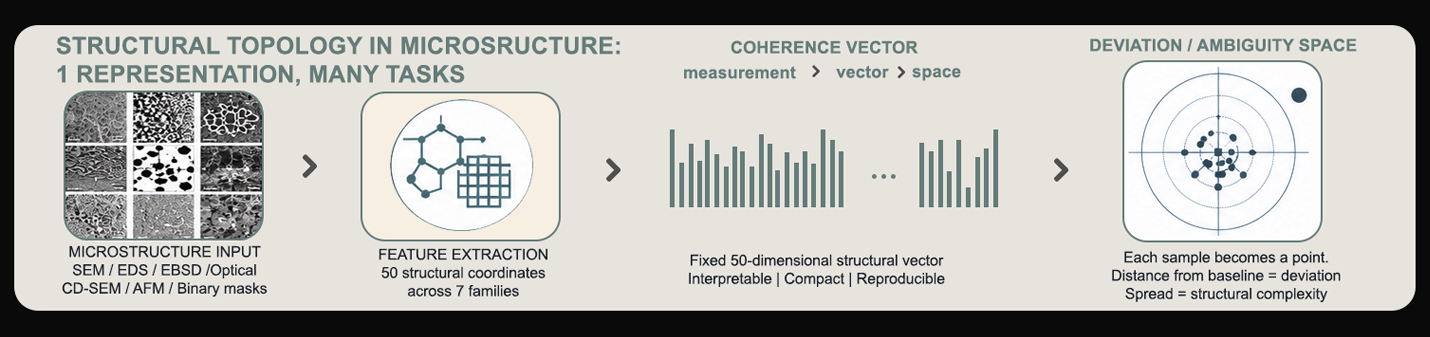
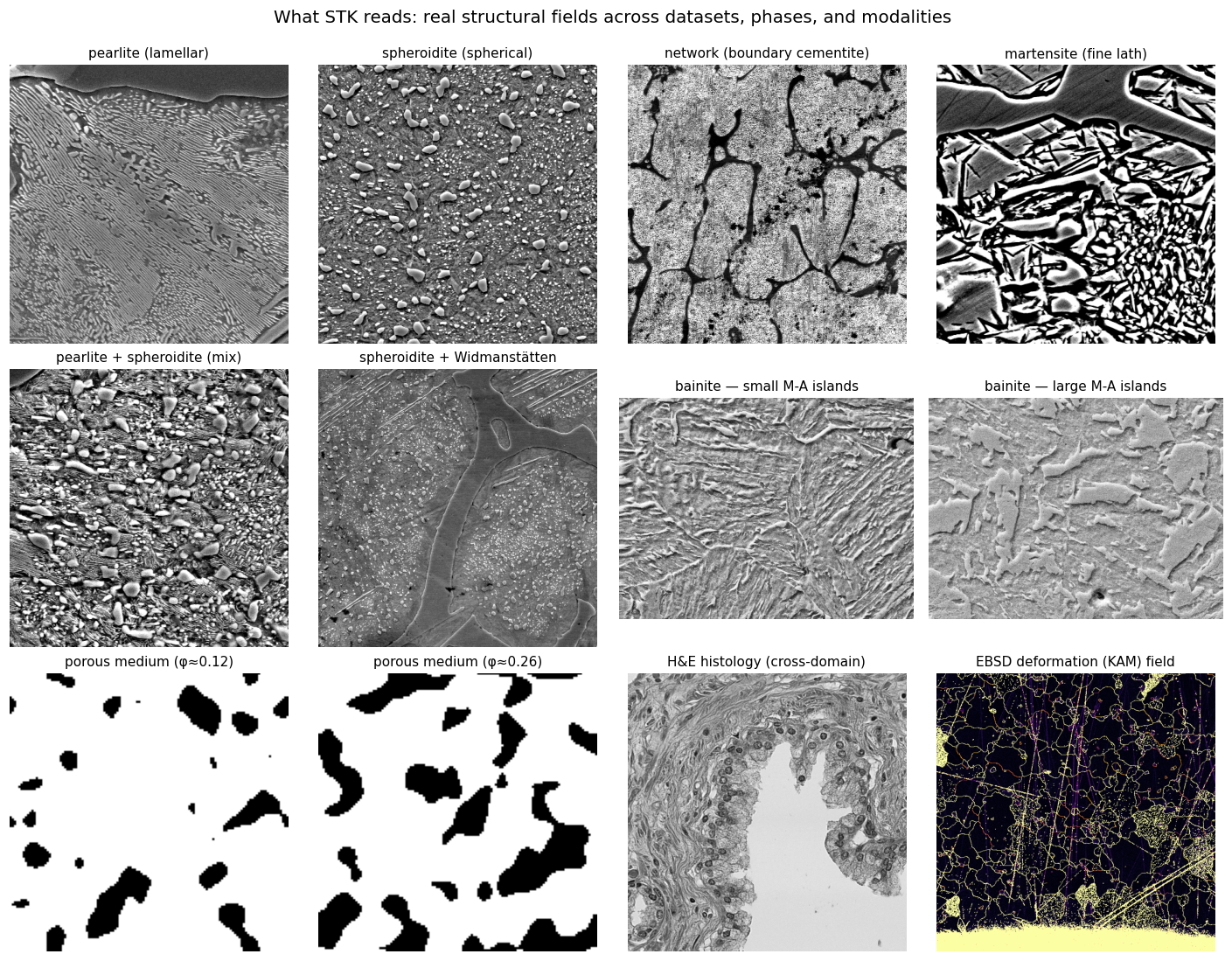
UHCSDB · 961 SEM images · 43 parent specimens · GroupKFold
0.832 macro AUC in the original evaluation, ahead of HOG and Haralick. A plain texture set does better.
On the UHCSDB ultrahigh-carbon-steel benchmark, STK-50 scores 0.832 macro AUC under GroupKFold by specimen — the correct evaluation respecting specimen structure, since 961 images derive from only 43 parents. The win is not feature compactness: STK also beats the dimensionality-matched PCA-50 union of S2+Haralick+HOG by +0.11. Removing all tonal, spectral, and edge channels leaves STK at 0.829 — the gain is structural, not an acquisition fingerprint.
Reading it today: those comparisons were against HOG and Haralick. A stricter re-evaluation (October 2026) used only the 803 images with a recorded specimen, nested grouped model selection and freshly computed features. In it, an ordinary 83-feature texture set (intensity moments, LBP, GLCM) reaches 0.761 against STK’s 0.70–0.73, and adding STK to texture does not clearly improve ranking (ΔAUC −0.040, interval −0.098 to +0.020). One exploratory result favours the combination: texture + STK lowers log loss from 2.47 to 1.49. STK is a strong general representation, not a better classifier than conventional texture features.
STK-50 grouped AUC
0.832
HOG (7200 features)
0.728
Haralick (196 features)
0.629
PCA-50 incumbent union
0.721
Stricter re-evaluation: texture-83 · STK-50
0.761 · 0.70–0.73
Bainite · 386 tiles · 26 specimens · 3-class M-A-island subclassification
0.964 AUC on a second steel dataset: the classification signal holds, though a texture set scores higher (0.979).
STK scores 0.964 macro AUC on bainite M-A-island subclassification under GroupKFold by specimen. The dataset is independently collected, different detector, different steel system, different task — yet the same fixed 50 coordinates produce a strong classification result. The signal is not dataset-specific; in the stricter re-evaluation an ordinary texture set still scores higher here (0.979 against 0.965). Breadth caveat: 26 specimens is moderate statistical power; the result is consistent but not as strongly powered as UHCSDB.
Bainite macro AUC (grouped)
0.964
Specimens
26 (GroupKFold)
Task
3-class M-A-island subclass
Same kernel?
yes — no retraining
2D Porous Media · Zenodo 17711512 · 2,000-train / 2,000-test · Lattice-Boltzmann ground truth
R²=0.939 — classical-descriptor tier on a fair field-governed property test.
2D permeability of binary porous microstructures is the sharpest test of whether STK reads property-relevant structure: it is 2D-governed (matching STK's 2D reading), and the mechanism is percolation and connectivity — exactly the coordinate class STK's island/resistance layer targets. STK-50 alone matches porosity + specific-surface + Euler + S2 and a connectivity-aware strengthened incumbent. The task-trained ConvNeXt ceiling (~0.995) represents fine pore geometry no 50-coordinate summary descriptor captures — that gap is expected and conceded.
STK-50 R² (held-out)
0.939
Classical incumbent (porosity+S2+Euler)
0.937
Porosity-only (Kozeny-Carman)
0.920
Added beyond strengthened incumbent (ΔR², linear · boosted)
+0.001 · +0.011
Task-trained ConvNeXt ceiling
~0.995
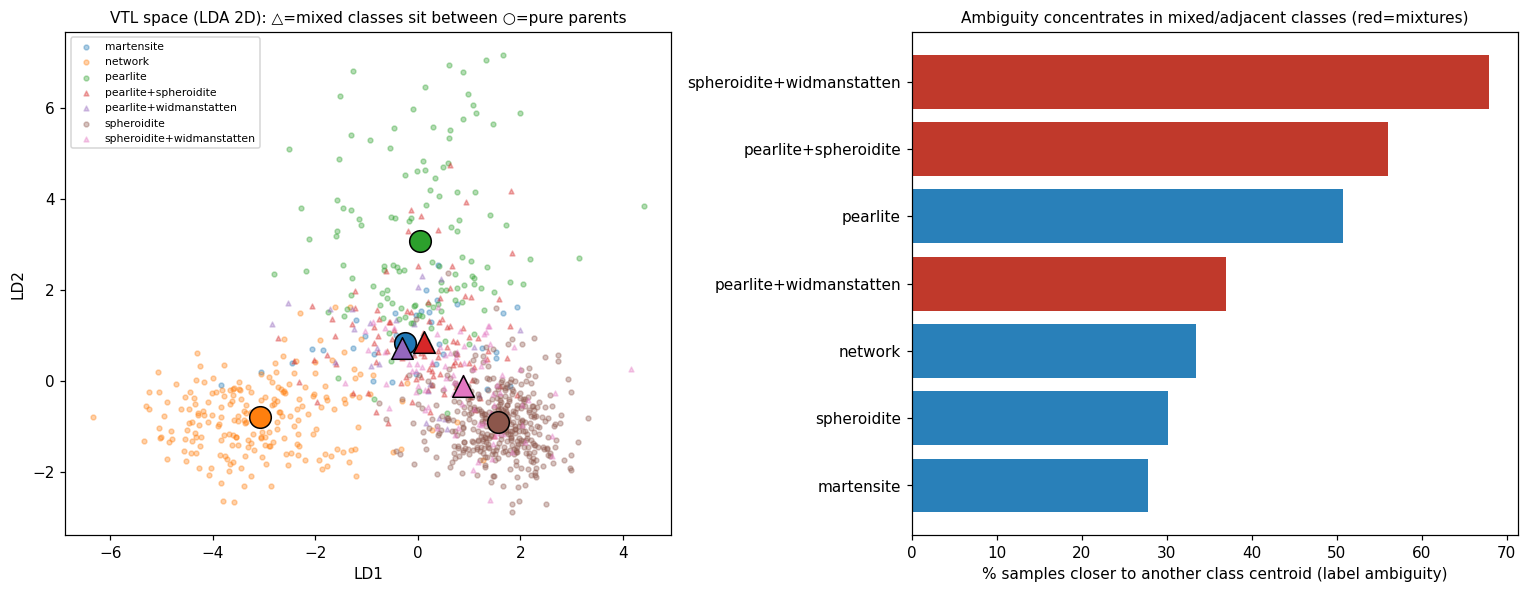
Label Ambiguity · UHCSDB Mixed Classes · Cross-domain: Gleason 2019 (6 Pathologists)
~40% of samples measurably closer to another class — concentrated in structural mixtures.
Microstructure "classes" are often continua forced into categories. STK provides a reproducible continuous position that places mixed classes between their pure parents and flags label ambiguity. The robust finding is the structure of this ambiguity: it is concentrated in mixed classes (56–68% ambiguous) and falls along structurally-adjacent class pairs, not at random. STK's ambiguity margin predicts the misclassifications of independent descriptors (HOG-error AUC 0.604, Haralick-error AUC 0.645) — the samples STK flags are genuinely hard for other methods too. Cross-domain mechanism check: ρ=0.26 convergence with six-pathologist disagreement on H&E (Gleason 2019).
Ambiguity in mixed classes
56–68%
Ambiguity in structurally distinct classes
28–34%
HOG-error prediction AUC
0.604
Cross-domain ρ (Gleason 2019)
0.26 [0.12, 0.38]
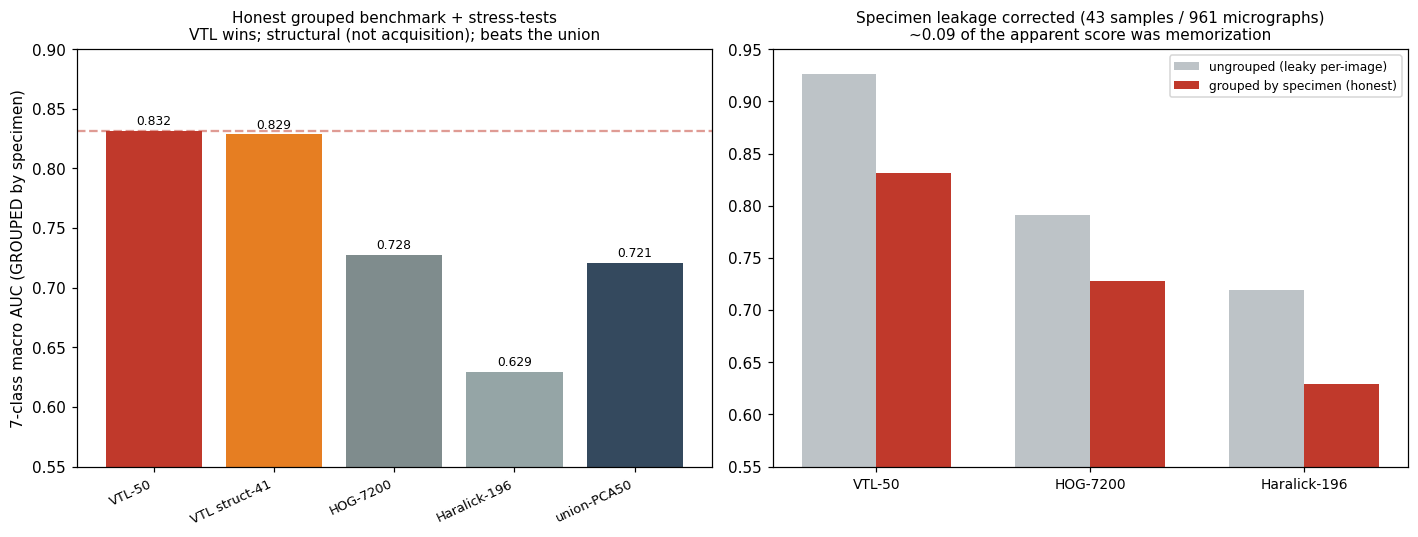
Left: grouped-by-specimen benchmark, original evaluation — STK-50 (0.832) ahead of HOG, Haralick, and their dimensionality-matched union; holds with acquisition channels removed (0.829). A conventional texture set, not shown, scores higher under stricter grouping. Right: leakage correction — per-image CV (grey) inflated every method ~0.06–0.09; grouped-by-specimen (red) is the honest number.
UHCSDB (DeCost & Holm)
7-class classification
0.832 AUC (grouped)
Strong · 961 imgs / 43 specimens
Bainite SEM (Figshare 19242903)
3-class M-A subclass
0.964 AUC (grouped)
Moderate · 386 tiles / 26 specimens
Ti-6Al-4V (18 conditions)
Rolling-temp. regression
R²=0.41, ρ=0.59
Small · 18 maps (grouped)
AlSi10Mg (8 states)
As-built vs. annealed
AUC = 1.0 (grouped)
Small · 8 maps (clean)
2D Porous Media (Zenodo 17711512)
Permeability regression
R² = 0.939
Strong · 2k train / 2k test
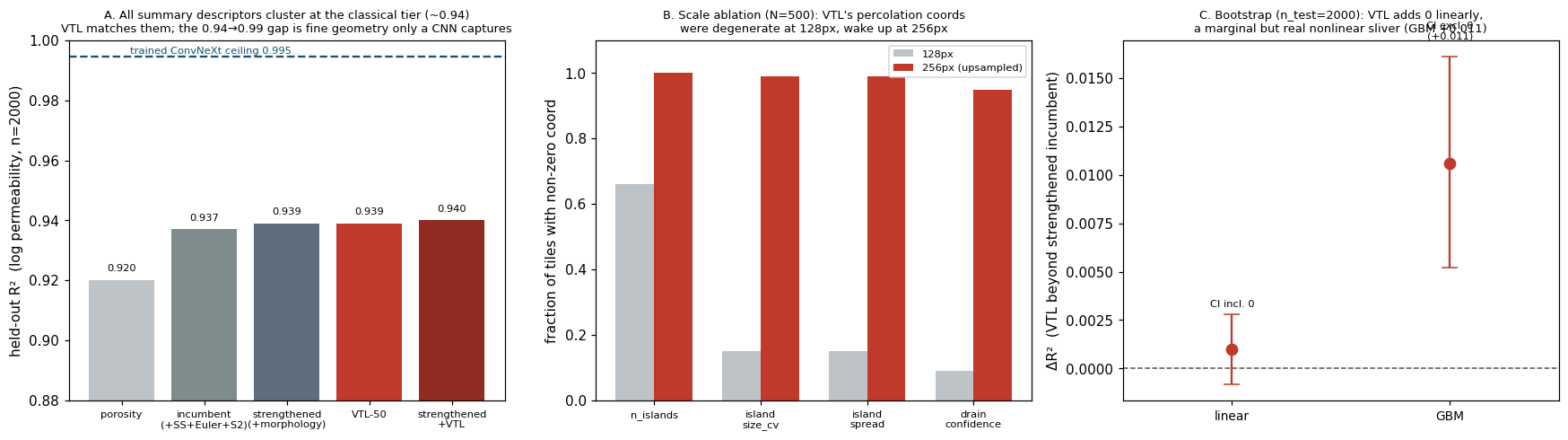
A: all summary descriptors cluster at the classical tier (~R²=0.94); the gap to a task-trained ConvNeXt (0.995) is fine pore geometry no summary descriptor captures. B: scale ablation — STK's percolation coordinates are degenerate at 128 px and wake up on upsampling to 256 px. C: bootstrap of STK's residual over the strengthened incumbent — zero linearly, a marginal nonlinear sliver under GBM (+0.011).
The claim boundary, stated directly.
STK does not beat task-specialized methods on any single benchmark, and on classification an ordinary 83-feature texture set ranks the steel classes better (0.761 against 0.70–0.73 under stricter grouping) — its value is that one fixed coordinate set operates at incumbent tier across tasks normally addressed with separate, non-overlapping pipelines. The permeability result is on a synthetic, noiseless distribution and a 2,000/2,000 subset; a task-trained ConvNeXt reaches ~0.995 that no 50-coordinate summary approaches, because the fine pore geometry that sets the last ~6% is compressed away. The label-ambiguity contribution is proxy-validated in materials with no native inter-observer gold standard; the mechanism is checked cross-domain only (Gleason ρ=0.26). Cross-lab breadth rests on one strongly-powered dataset (UHCSDB) with bainite replication at 26 specimens. STK is not computationally cheaper than simple topology descriptors. The boundary is part of the contribution: STK is a portable structural measurement layer with a now-characterized ceiling, not a magic residual-finder.
+0.11
AUC above
dimensionality-matched
HOG/Haralick/S2 union
0.829
AUC without
acquisition-sensitive
tonal channels
not a
specialist
generalist tier
across tasks,
not task-winner