Instrument Pipeline
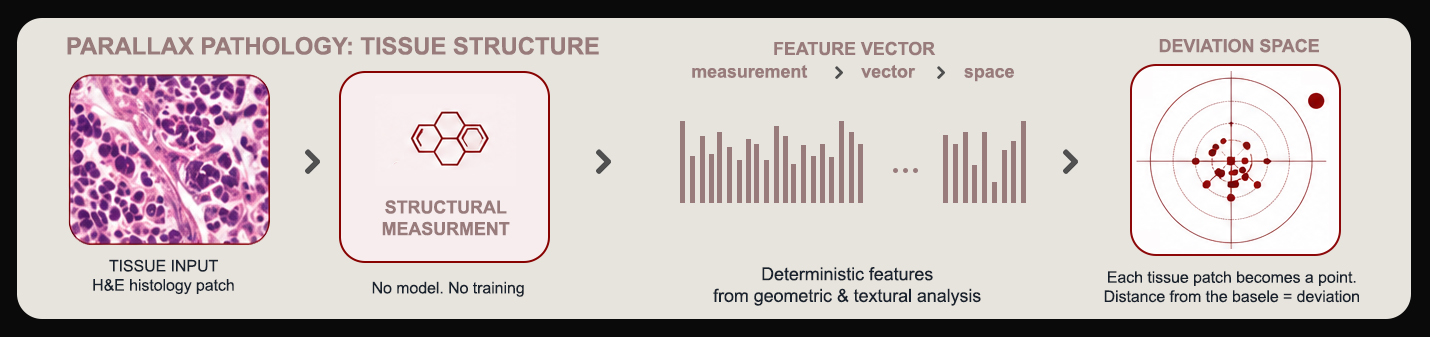
Parallax Pathology v4.1
A deterministic, training-free structural measurement system for H&E histology. Sixteen structural theories. Fifty-eight axes. No labeled pathological examples required.
Rather than learning what pathology looks like, the system learns what normal structure looks like, and measures deviation from that norm.
Foundation models trained on millions of labeled patches achieve 95–99% accuracy on standard benchmarks. Their predictions are confident and often correct. But they require large labeled datasets of pathological examples, and they cannot explain which geometric properties drove the prediction. They produce a verdict, not a reading.
The system encodes the structural laws of normal tissue, what orientation coherence, void topology, boundary permissiveness, and tonal distribution look like when tissue is doing what tissue of its type does. Deviation from those laws is the signal. A rare disease the system has never seen will register as structurally distant from all known normals. That is not a misclassification. It is the correct output.
Six structural axes (Δᵣ, θ, Γ, k_rv, highlight_mass, midtone_mass) plus 52 additional geometric, texture, and microstructure features. The frame defines how structure is measured, not what structure should be. It does not change between a colorectal biopsy and a breast biopsy.
Ω(x) = √( Σᵢ wᵢ · (xᵢ − μᵢ)² ) where wᵢ = 1/variance. A continuous scalar measuring how far a patch sits from the structural expectation of a chosen reference class. Decomposed by axis, the source of deviation is always named.
A reference distribution built from representative normal examples of any tissue type. The memory is not part of the instrument, it is context provided to the instrument. Swap the memory for breast, kidney, or skin tissue. The frame stays. This is the Library of Normals architecture.
Instrument Pipeline
1,800 Macenko-normalized 224px patches across 9 classes. Every tissue class shows visually confirmed canonical/deviant separation. Deviant TUM patches stratify into two geometrically distinct failure modes corresponding to mucinous differentiation and desmoplastic reaction, detected from geometry alone, without pathological labels.
Six-class dysplasia grading from Normal through Adenocarcinoma (n=920, 224px PNG). Adjacent classes overlap structurally by nature, but this is not a classification problem, it is a measurement problem. 84.3% of predictions are correct or within one adjacent grade step. The system correctly places serrated adenoma structurally distinct from conventional low-grade neoplasia, consistent with its separate BRAF molecular pathway.
Three independent GTEx whole slide images (PAXgene fixation, different preparation method from the formalin-fixed CRC-VAL data). Structural centers emerge independently within each donor without labels. Within-set Ω distributions (mean 2.09–2.26) are consistent with CRC-VAL results. A preparation chemistry finding: Δᵣ inverts its role in the deviation field between fixation methods, correctly detecting a real property of the tissue-chemistry interaction.
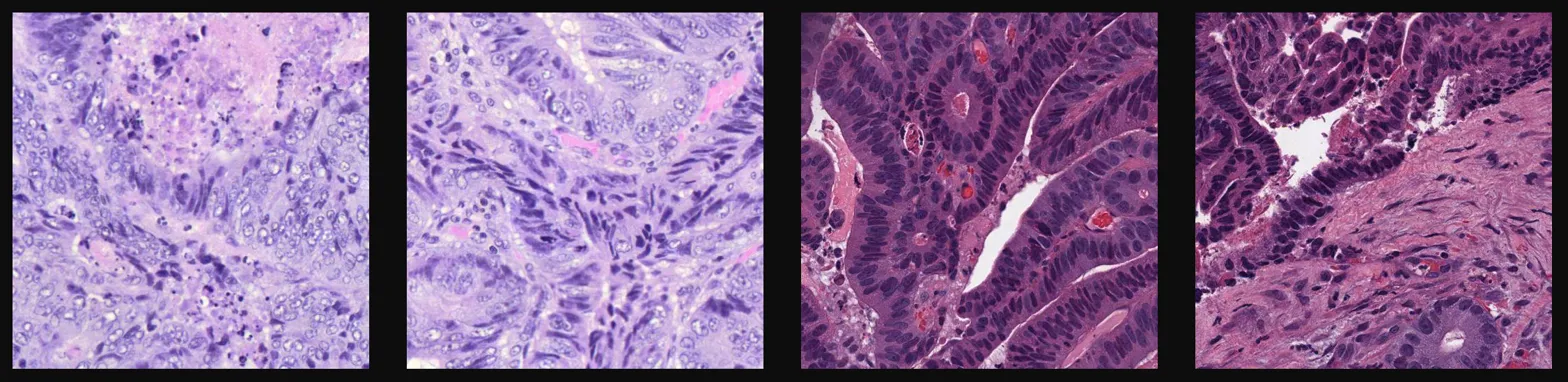
highlight_mass jumps from canonical mean 0.229 to 0.54–0.61. The tumor field opens, cellular density gives way to optically permissive space. Geometric signature corresponds to mucinous differentiation, intratumoral necrosis, or poorly cohesive growth, detected without training on either.
θ jumps to 0.12–0.13, nearly five times the canonical TUM mean of 0.024. These patches have acquired directional structure that the tumor normally lacks. Geometric signature corresponds to desmoplastic reaction: host stromal fibrosis within the tumor field.
TCGA-COAD survival analysis (n=180 colorectal patients, 47 OS events). The pre-specified primary hypothesis, that mean structural deviation (Ω) predicts overall survival, was not supported. HR=0.87, p=0.30. This result is reported directly, not minimized. It is also informative: the average tumor state does not predict outcome. What predicts outcome is how the structural state is distributed across the tumor. Intra-tumor structural variability and tonal density were significantly associated with survival independent of pathological stage. The Tumor Consolidation Index stratifies patients with observed mortality of 15.0%, 26.7%, and 36.7% across tertiles. Concordance index on disease-specific survival: 0.850, without any outcome training.
Confident categorical prediction. 95–99% accuracy on standard benchmarks. Optimized for classification. Requires large labeled datasets of pathological examples. Cannot explain which geometric properties drove the confidence. The gap in accuracy between deep learning and Parallax Pathology is real and expected, it reflects genuinely non-geometric information that no hand-designed feature encodes. This gap is not hidden. It is documented explicitly in the paper.
Continuous deviation scalar. Axis-level explanation built into the measurement itself. No training on pathological examples. No training distribution, high Ω on an unseen tissue type means the geometry does not fit any known structural regime. That is not a misclassification. It is the correct output. Rare diseases surface as high-deviation from all normals.
The structural metric vector, 58 deterministic scalar outputs per patch, is a structured, biologically interpretable feature representation. It can be concatenated with any foundation model's learned embedding. Using Ω as an out-of-distribution signal alongside a deep classifier produces a system that is both accurate and capable of flagging patches outside the training distribution. The intended relationship is hybrid, not competitive. The 91.5% figure is evidence that the measurement space has real geometric structure. Its value as a hybrid component is not bounded by that ceiling.
References for breast, lung, kidney, and skin have not been built. The architecture supports them. Building each requires only normal tissue examples, not labeled pathological material.
The current benchmark is fixed at 224px. The hypothesis that tissue-scale fiber organization reads more cleanly at larger field width requires tiling from source WSIs. The experiment was designed; the data was not available.
No correlation between structural deviation and pathological grade, molecular subtype, or clinical outcome has been formally validated. TCGA-COAD is exploratory. This is the most important open question for translational relevance.
Multiple biopsies from the same patient produce a trajectory in Ω space. Tissue drifting toward a pathological state should show increasing deviation before a defined histological diagnosis. Serial biopsy datasets with known outcomes are required to test this.
Tonal axes carry staining-protocol sensitivity. Macenko normalization applied to TCGA-COAD would cleanly separate the staining artifact from the architectural signal. If highlight_mass survives normalization, the finding is architectural.
The 58-axis structural vector as a feature layer concatenated with UNI or CONCH embeddings. The combination carries both high-accuracy learned features and geometrically interpretable structural measurements. Not yet tested.
Parallax Pathology extends the Visual Thinking Lens (VTL), a geometric kernel originally developed for compositional analysis of AI-generated images and visual art. The same field-agnostic primitives (centroid, void ratio, orientation coherence, spatial dispersion) that describe compositional structure in paintings describe tissue architecture in H&E sections. The frame is universal. The application is not.
The system is explicitly not competing with foundation models. It is asking a different question with a different instrument: how far can deterministic geometric measurement go? At 91.5% nine-class accuracy without any training, the answer is: further than expected. The 16.3pp emergence gap confirms that the structural layers encode genuinely complementary information, not redundant signals averaging together, but a genuinely new capability from their combination.