Instrument Pipeline
Measure it.
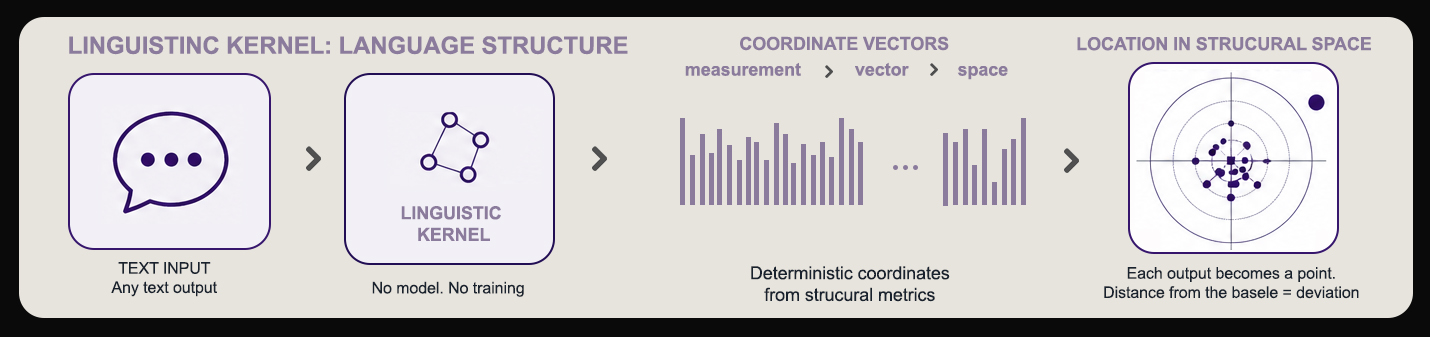
The Linguistic Kernel is a behavior-only instrumentation layer for large language model outputs. It reduces any text string to a reproducible coordinate in structural space, without calling another model, without semantic judgment, without guesswork.
Most evaluation frameworks for language models fall into two categories, and both have fundamental problems.
Tells you how a model behaves on curated test sets under controlled conditions. Tells you nothing about structural behavior under production pressure, across conversation turns, or when output constraints are stressed.
Introduces the circularity it is meant to avoid. You are using a stochastic, non-deterministic system to evaluate another stochastic system. The judge has its own structural biases, its own failure modes, its own drift.
The same input always produces the same output. No model in the loop. No stochastic components. Every number is backed by countable evidence features.
Every coordinate has a countable source. The evidence bundle exposes all raw features that drove the computation. Nothing is hidden in a neural network's judgment.
Measures only what is visible in the produced text. Works identically on GPT, Claude, Gemini, or any open-weight model. No model-specific calibration required.
The kernel reduces any text to a point in an eight-dimensional structural space. The first four are the canonical core. The second four are auxiliary. Each dimension is computed from a different countable feature of the text.
Where informational mass lands across the response. Front-loaded vs. back-loaded vs. centered. Computed as a weighted centroid over sentence position.
Structural air and breathing room. Captures paragraph density, bullet structure, short-sentence proportion, and average sentence length in a single composite.
Concentration of content-bearing tokens relative to connective language. High values mean lexically dense, information-packed delivery. Low values mean connective tissue dominates.
Continuity of discourse scaffolding. Counts transition markers and reference pronouns that stitch sentences together. High cohesion means explicitly linked structure.
Average sentence length relative to a 15-token neutral baseline. Tracks punctuation suppression, verbosity constraints, sentence boundary collapse.
Edge-seeking behavior. Measures word rarity against a 6,355-word common-English baseline (Zipf-grounded). Domain-agnostic: jargon in any field scores high.
Non-linear jumps between adjacent sentences. One minus mean cosine similarity between neighboring sentence token distributions. High values mean abrupt topic movement.
Clause stacking and subordination density. Counts true subordinating conjunctions and weighted punctuation markers per token. Measures sentence layering pressure.
Every kernel computation passes through a deterministic five-stage pipeline. No external service. No randomness. No hidden scoring model.
Text is split into words, sentences, and paragraph blocks. Bullet lines handled as structural units.
›Count every feature: tokens, sentences, transitions, pronouns, subordinators, contrast markers, rare words, metaphors.
›Evidence features transform into the eight kernel dimensions via defined, versioned mathematical functions.
›Basin assignment and rhetorical state derived from coordinates. Z-space normalization applied when a prompt-family baseline is fitted.
›Coordinate, basin, evidence bundle, rhetorical state, segmentation flag, and full versioning metadata returned as a structured dictionary.
from kernel_v19 import LinguisticKernel

kernel = LinguisticKernel()

result = kernel.compute("Your LLM output goes here.")

# → kernel coordinate
result["kernel"]    # {"Δx": 0.004, "rᵥ": 0.068, "ρᵣ": 0.676, "μ": 0.490}

# → auxiliary dimensions
result["aux"]       # {"Δy": 0.85, "xₚ": 0.567, "θ": 0.880, "dₛ": 0.526}

# → rhetorical state and basin
result["basin"]     # "B0_centered_compact"
result["evidence"]["rhetorical_state"]  # "assertive"

# → every count that produced those numbers
result["evidence"]  # full audit bundle
Understanding the limits of a measurement instrument is as important as understanding its capabilities.
Because the kernel is deterministic and engine-agnostic, it composes into a range of operational and research applications.
Record each prompt family's usual readings, then compute the kernel on sampled outputs. When a family's readings move, the kernel says which way: longer, denser, more first-person, shorter sentences. Movement is a reason to look at the answers, not a verdict on them.
Run the same prompt family through multiple models. Compare where each engine's answers sit and how widely they spread under identical conditions. Different engines have different structural fingerprints, make those differences measurable.
Apply controlled edits (added constraints, polarity flips, length caps) and measure what changes. Sentence counts, lengths and punctuation are counted directly, so whether a formatting instruction was followed, and which one wins when two collide, is a measurement rather than a judgement.
Track the readings turn by turn across a conversation and see whether structure wanders and whether it comes back. Which patterns of drift matter is an open question; the kernel makes the trajectory measurable so it can be studied.
A tail check on every response flags answers that stop mid-formula or mid-code: unbalanced braces, dangling operators, unfinished LaTeX, unclosed code fences. Under batch load these cluster on derivation-heavy prompts and differ sharply between engines. A flag marks an answer to read, not a verdict: complete answers can trip it too.
Record the structural side of adversarial tests alongside the semantic review. Constraint stacks, contradictions and format attacks move the readings in characteristic directions, which gives each test a reproducible structural record.
Instrument Pipeline
The kernel has been run on 1,200 responses from Gemini, GPT and Claude answering the same 400 prompts under batch load, on 300 Gemini responses to 60 prompts repeated five times, and on 60 GPT-4o responses with token-level probabilities.
It separates what the prompt sets from what varies run to run, distinguishes engines by how they allocate output, catches answers that stop mid-formula, and shows a measurable link between clause density and the model's own generation uncertainty.